How do you weigh up medical advice?

I’ve been visiting family and friends, and as often happens, we compare medical notes. How easy is it to visit your GP? Who has the worst osteoarthritis? What medication have each of us been prescribed for high blood pressure? All of our social networks and norms are in play. Our family has a tendency to regard illness as a weakness,, and any visit to the GP involves careful callibration against the family norms.

One sister prefers to seek alternative solutions, changing her diet, drinking apple cider vinegar for her joints, and doing yoga. Another does not vist her GP or look for health issues on the internet, but pursues a very healthy lifestyle. My brother has sought private advice, my mother has checked with multiple medically-qualified relatives and friends. My dear dead dad used to boast about the top specialists he used to see, but would check in with me to see if I had heard of them, for validation.

Ever since I started medical school, I have been a sounding board for all sorts of friends and relatives, even before I had started my clinical years. In recent years, this has increased in frequency, and I have been wondering about this. Do people trust their GP and other qualified health professionals less? We can check everything on the internet, but sometimes that information is unreliable.

There are a number of factors in play. First of all, access to the internet has been growing over the last twenty five years. Artificial intelligence means that search engines can prioritise and summarise information quickly, no appointment required, any time and anywhere. Official sources of information such as NHSinform and patient.info can be a boon to health professionals, who can signpost to them for a modern take on the information leaflets we used to stock, and more likely to be up-to-date. Specialist websites provide a sense of community and support for conditions such as diabetes or muscular dystrophy. However, reliance on digital support for healthcare marginalises some groups. Statistically, older women are the least likely to be IT literate or to trust digital solutions, but low income, deprivation, language and cultural barriers are all in play. The affluent, urban, busy professional has become the target audience.

As a health professional, when I speak to a patient with high levels of understanding of their condition, and good health literacy, this is both a blessing and a stress. The fully engaged patient can participate in discussions about various health care options, can evaluate information, and challenge my own assumptions and knowledge base. This same group of patients may defer decisions so that they can evaluate and research their health questions further. It can be time consuming and intense, and of great value to the patient.

The second factor is less tangible than reliable information. It is trust. In our modern NHS, there are fewer GPs per head of population. At the same time, an older and less healthy population requires more health care. I could expand at length about the reasons for the reduction in whole-time equivalent GPs, but that is for another day. The upshot is that it has become harder to get an appointment with a GP and harder to see a GP that you have seen before. Continuity of care is disappearing, a loss to GPs and patients alike.

I polled a group of friends and relatives where they sought healthcare advice. The general approach seems to be to consider what issue to address, then to speak to friends and relatives first, perhaps supplemented by google. Only about half of these discussions led to a GP being involved at all, and any outcomes were further reviewed with relatives and friends. Clinically trained relatives, and those with the same condition, were the favoured sources of advice and discussion.

I asked these same friends and relatives about whether they usually saw the same GP, and whether they trusted their GPs. None of them could say who their GP was, or saw the same GP each time. Only half of them said they trusted their GP. I will quote one perspicacious reply:

How telling. The erosion of continuity of care has eroded trust and understanding, nuance and personalised medicine. Increasingly available and more complex information makes it harder to discriminate and evaluate the reliability of the information, how much weight to give it and whether it applies. Without trust from a wise navigator, where is realistic medicine? How do people without a clinically qualified relative cope? If General Practice has been reduced to a ‘painting by numbers’ service, how can personalised choices be considered?

Realistic medicine saves the planet? Sustainability, environment and health

I am Dr Kate Dawson, one of the GPs at Benbecula Medical Practice in the Outer Hebrides. I have been working here since 1990, with three short breaks to complete some training, and when I had my babies, who are now grown up. We are lucky to live in a beautiful and precious place, which is generally safe and kind. I love gardening, knitting, and observing our wildlife when I am out walking.


Our islands, though, are very vulnerable to change. Global warming is bringing unpredictable weather, and rising sea levels will change our coastlines. It is getting more difficult to recruit staff, and travel links are not as good as they were a few years ago.


In the face of this, I have been considering the sustainability of the healthcare system that I am part of, and how we can make positive changes that will help our patients achieve better health, and at the same time, reducing our impact on resources. I dived in to think about this in more detail in the last year and found more than I thought possible.


What does sustainability and the environment mean in terms of health care? Here are some of the ideas that may affect patients directly. Some items will not surprise you, others might.

  • Patient transport. This includes trying to use active transport such as walking and cycling, using electric bikes and electric cars. This can be hard when distances are long, and our roads are narrow. However, this also includes trying to avoid travel to appointments when a phone call or video link would be as effective.
  • Waste management: Unused medication should be returned to the surgery for safe disposal, so it does not cause environmental contamination. You can also help by only ordering what you need when ordering repeat prescriptions. Empty inhalers and insulin pens should be returned to the surgery. Incinerating empty inhalers causes less damage than the gas in the inhaler being left in the environment.
  • Better prescribing: As an example, inhalers have a particularly detrimental effect on the environment. One MDI inhaler is as damaging as a drive to Inverness, whereas one breath-activated inhaler is equivalent of a drive between Griminish and Balivanich. Unnecessary and ineffective medication is a waste too. Don’t cut down on your inhalers, get advice about managing your asthma more effectively, use your preventer more, and ask to try a switch to breath activated inhalers.
  • Better decisions: Better discussions about treatment and referral help patients and doctors make better decisions. If you are referred for a treatment that you Don’t really want, or which may not benefit you much, then it is far better to discuss this before the travel, prescribing, tests and worry begin. It begins with talking frankly to your GP about the benefits, risks, and alternatives to the proposed treatment, and to ask what would happen if you did not seek treatment. Take someone with you if you need support with these discussions.
  • Good health is more than medication: Our current medical model from the twentieth century has been about patients coming to the doctors, their ailments quickly assessed, and a treatment or procedure prescribed. With authoritarian health care, the patient can become a passive recipient of medical care, and every ailment is met with a treatment or a procedure. There may be another healthier, less wasteful, more sustainable way.

Imagine this; you can improve your appearance, reduce your need for medication, your reliance on health care, improve your energy levels and joy in life, the benefits will last for years, and the cost is minimal. I am really excited with the possibilities. What is the secret? What if everyone could do this, it would reduce reliance on health care resources, and we would live to enjoy health into our retirement. I am talking about improving health by improving fitness.


As an example, the most cost-effective treatments for Chronic Airways Disease (COPD) are physical activity, smoking cessation, and flu immunisation. These three things are associated with better outcomes than any inhaler or medication.


I am using the word ‘fitness’ for a good reason, as it covers lots of concepts. It does not focus specifically on weight, or exercise, or smoking, or alcohol. It just focuses on being healthier. Where should you start? The beginning is to think about what you want to improve, to imagine what your goal is, what is driving you to consider making a change. Give yourself permission to write down or say aloud what you want to change, what could be better. Perhaps you want to be less short of breath, or your knees to hurt less, or to feel less lonely. Your goal will inspire you to keep trying. You could list all the things you might want to change and work out what you need to do for each thing.


Don’t try to change everything all at once. It is better to focus on one easy thing at a time and make it about fitness and fun. This year, for example, I plan to go for a walk at least once a week. If I miss a week, I have given myself permission to try again the next week, and not to give up when I fail. Last year, we started using smaller plates to reduce our portion sizes without cutting out our favourite foods. You Don’t need Lycra, or to run, or to go on an extreme diet, just find one thing that you can do, that you can enjoy, and make that into a habit that you can sustain.


Who are your allies? Have you got a trusted friend to talk to? A professional such as a physiotherapist, counsellor, nurse, or doctor could listen and support you, if you asked for this; the most important thing is to find someone who can listen to you. They may help you work out what you might be able to do next, to identify one thing that you can do easily, and to support you too.
Your one change may bring more benefits than you think. Going for a short walk will improve your fitness, and it will also raise your mood, reduce isolation, and ease joint pain. Meeting up with someone else for an activity such as knitting or singing will improve your mental agility, and will also reduce isolation, low mood, and loneliness.


As you start to improve your health, you may inspire others. We could have a new normal, in which we support each other to take steps to improve our health through simple changes to our lifestyles, reducing our reliance on medication and leading more fulfilling and joyful lives. We can help the environment and the NHS stay sustainable by creating our own better health.


For ideas, why not listen to Michael Mosley’s podcast ‘just one thing’ on BBC sounds.
https://www.bbc.co.uk/programmes/p09by3yy/episodes/downloads
Letters to patients

As well as being a GP, I have been working in secondary care as a GP with a special interest in Dermatology. Around five years ago, I was feeling very annoyed with one of the practices that refers to the dermatology clinic. Patients were attending for review without having tried the treatment that I had suggested.

The dermatology clinic is usually rammed, and these appointments were adding unnecessary pressure on the clinic, wasting patients time, as well as adding a longer burden of ill-health due to skin disease. Nobody was happy.

I could have written to the practice and had a strop, but the practice involved was struggling to recruit partners or salaried GPs. They were relying on locum cover, and there didn’t seem to be an end in sight. In addition, other patients in other practices didn’t always seem to understand their treatment plans.

An aside here: most patients with chronic dermatological conditions have complex treatment regimens. This could include a pre-washing emollient, a soap substitute, a moisturiser, then a topical treatment, to be titrated up or down, and tapering to other treatments. Very few patients and GPs manage to get this all down at the first attempt.

I started writing my clinic letters direct to the patient with a copy to the GP, with consent. Nobody turned me down. The best responses were from relatives of patients with dementia, where a written care plan was useful for the team of carers. At the clinic, patients were advised to check with their practice for their prescription when they received their copy letter.

I didn’t do this as a proper improvement project, I didn’t measure follow-up outcomes, patient satisfaction, and I didn’t have a ‘spread’ plan. However, the feedback was immediate, and positive. GPs were in favour: they no longer have to contact patients to check up on new prescriptions. Patients were in favour, finding it helpful to have the treatment plan written down in the letter. Relatives were in favour, having a documented plan to follow. The secretary confirms that there is no additional work in doing the letters this way.

After 3 years of doing letters this way, I’m beginning to see other clinicians trying this out. Patients bring their letters to GP consultations, ready to discuss their treatment as more equal partners. I have been asked to advise other clinicians about how to structure their letters.

The biggest and best outcome is patients as equal participants in their treatment, and communication about their health. It is a culture shift, and it is gradual, and I am part of it.

Indication prescribing

I have come across something so simple, so easy to do, and so intuitive, that I can’t believe that I haven’t always done it. It helps patients understand their medication, and enables better conversations about concordance between patient and prescriber.

It is indication prescribing. I have always done this for PRN medications, without even thinking. For example, if I prescribe paracetamol, the prescription says ‘take two tablets four times a day for pain’.

Now, when I add a repeat prescription, I am adding ‘take one daily to treat high blood pressure’ or ‘take one tablet before meals to ease symptoms of irritable bowel syndrome’. So far, it has had good feed-back, it costs nothing, and it moves the responsibility for compliance, concordance, for treatment towards a more patient-centred model.

There will always be the patients who state that they only take four white tablets at breakfast, or one of my more memorable old ladies who used to keep her many medications in a bowl like pan-drops and helped herself to a few each day.

I hope, by making Indication Prescribing the norm in our practice, that these patients will become the outliers. For each medication review by prescribers and the practice pharmacist, an opportunity to make this become the way things are done around here.

Link workers and Realistic Medicine

My last post was a poem that really struck me. I’ve been wondering why, and I think it was because it articulates the need for help to be practical, to be real, and to have relevance and credibility for the person accessing that help. Just wanting to help, wanting to be useful, is not the full story.

What attributes would an effective link worker have? They’d have to be comfortable around people, good at connecting with professionals, community groups, officialdom and patients. They’d be able to gain trust, and then walk alongside people who may be disempowered in the face of the clinical professions, enabling communication. They’d need to be enquiring, able to find out and keep in contact with key people within organisations, to understand how to get the best from them. They would be able to understand the needs of each person that they support, and advocate for those needs to be met.

What evidence do we have that individuals need this kind of support?

% who can ask

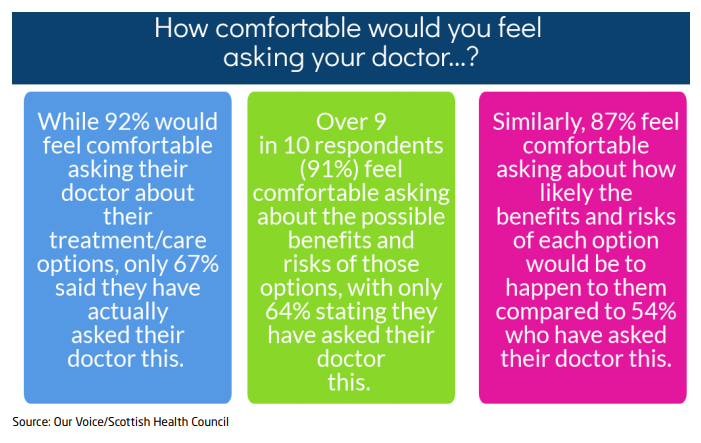
We know there is a gap, data tells us that even though patients tell us they could raise questions in a consultation, in reality, this doesn’t always happen. For 10% of patients, they know they won’t ask if they don’t understand. For a further third, they think they could ask, but in reality they don’t. It is those with the least health literacy that need this support the most, otherwise realistic medicine is going to be beyond their grasp.

The new GP contract includes an aspiration for employing link workers so that every General Practice has access to a link worker, and that link worker can work with patients without need for a separate referral. It remains to be seen whether the people that need this support the most get the most access.

So, it seems to me that our link workers could be powerful allies for patients, decoding the language that is already building up around the concepts of Realistic Medicine, and keeping it basic, keeping it real, and keeping the patient at the heart of our consultations.

We don’t have a link worker identified in our area yet, but she or he will be on the project team.

Patients and quality in health care – co-production at scale.

If you type patients, quality and care into google, the results suggest that this is something that we do for and to patients. Discussions about change agents take me to pages about how to engage clinicians within the healthcare system, but nothing directly about patients as systematic change agents.

I want to flip this on it’s head, and inspire patients to shape the health service, seeking provision that meets what matters to them. A 180 degree revolution. Clearly, there needs to be some strategy, some oversight from health care providers, so that those with greatest need don’t lose out to those with the strongest lobby. Both parties are required to create the service.

The current term for this process is co-production. On a personal level, working as a GP, this is our bread-and-butter. An effective consultation supports the patient with diagnosis, providing information, management choices, and opportunities to meet again to discuss progress.

While I was looking for articles about patients as change agents, I came across the concept of the Patient Activation Measure, a tool to assess how ready patients were to engage in these discussions. The tool is used on an individual, case-by-case level, where the doctor-patient relationship and the problem to be managed is the scope of the co-production. How could we lift this to a more strategic level? Could we use the Patient Activation Measure to see how successful systemic change is in increasing the number of patients able to use the tools of realistic medicine, able to develop that agenda with the clinicians they meet?

As a GP partner in Scotland, I am responsible for ensuring that our practice systematically provides safe appropriate patient-centred care. We provide opportunities for patients to feed back to us about their experience of healthcare, and give us suggestions about improvements. These tend to be about small things – how comfortable our seating is, whether we should have Radio 2 or another station in the waiting area.

Nationally, Care Opinion collects patient feedback, enables organisations to respond and reply, as well as being searchable. But this doesn’t of itself, change the relationship between clinicians and the public. Much of the positive feedback includes stories about care where the principles of Realistic Medicine has been at the heart of care. Within this movement, I feel I am getting closer to system-wide patient-led quality improvement.

The place where I feel this project really sits is as part of the House of Care. I seem to be trying to create an environment in which the left-hand wall is nurtured. Imagine a house which has, at it’s centre, conversations about care, support, realistic medicine. The foundation and floor is the social context, all of the sources of support in a community. The roof, sheltering this all, is the system and processes that bring the patient and clinician together. The conversation has on one side, individuals ready to engage in a therapeutic dialogue, and on the other, clinicians who are committed to partnership working with patients.

House of care

So far, most of the Realistic Medicine discussions that I have been involved in have focused on the clinicians, the ‘right-hand wall’, and on the roof. However, we could possibly be talking only to each other, unless we have individuals and carers that are speaking the same language, individuals and carers who can start these conversations spontaneously.

This model allows for work at local, regional and national scale. The British Heart Foundation has just published a report on a three-year project that used the House of Care Model in five health communities. The report describes how patients were involved in championing this approach, how important an enabling infrastructure is, how to flex the model to fit local need, and the importance of culture before paperwork.

I’m feeling inspired.

References (accessed on 11/10/2018):


Who was Warner Slack?

Subtitle: Why communication technology matters.

I read last week’s BMJ obituaries, as I often do. (read the article HERE) The main tribute reflected on the work of Dr Warner Slack, who believed that ‘the patient is the largest and least utilised resource in healthcare’.

As I read further, I was astonished at the foresight of his vision. In the 1970s, with others, he set up the Center for Clinical Computing at Harvard, and created one of the earliest hospital information systems. He wrote much about clinicians and information technology, but the area I wish to focus on today is his vision of patient-clinician partnership, enabled by Information Technology.

Dr Slack trusted the agency of patients to use automation for their benefit decades ahead of his time. His underlying inspiration was that computing and information technology would empower clinicians and patients. He wrote about online patient communities, now a reality, with websites such as Patients like me and Smart Patients empowering patients to find out from others about the experience of their conditions, and the reality of treatment choices.

He also believed that patients should have access to their digital records, and now we have the OPEN NOTES movement.

I believe that patients need time to understand what we have told them, have the right to consider what we have recorded in their notes, and to consider the implications of their condition and the treatments that they are choosing between. This access, alongside health literacy, means that patients are on the therapeutic team for their own care.

I’ve had a look at the Primary Care Digital Services analysis of what we are working towards, and patient access to their clinical notes has been classified as High Input, Low Impact, meaning that it will be low down on the list of projects being progressed. I know that this is already part of the English GP contract, so it can be done.  This week’s mission: to find out whether this access is coming across Scotland, across the Western Isles, and on Benbecula.

Also, to link the blog to the practice website and the practice patient participation facebook page. (Done)

I’m inspired by Dr Slack, whose ideas are so relevant to Realising Realistic Medicine.