How do you weigh up medical advice?

I’ve been visiting family and friends, and as often happens, we compare medical notes. How easy is it to visit your GP? Who has the worst osteoarthritis? What medication have each of us been prescribed for high blood pressure? All of our social networks and norms are in play. Our family has a tendency to regard illness as a weakness,, and any visit to the GP involves careful callibration against the family norms.

One sister prefers to seek alternative solutions, changing her diet, drinking apple cider vinegar for her joints, and doing yoga. Another does not vist her GP or look for health issues on the internet, but pursues a very healthy lifestyle. My brother has sought private advice, my mother has checked with multiple medically-qualified relatives and friends. My dear dead dad used to boast about the top specialists he used to see, but would check in with me to see if I had heard of them, for validation.

Ever since I started medical school, I have been a sounding board for all sorts of friends and relatives, even before I had started my clinical years. In recent years, this has increased in frequency, and I have been wondering about this. Do people trust their GP and other qualified health professionals less? We can check everything on the internet, but sometimes that information is unreliable.

There are a number of factors in play. First of all, access to the internet has been growing over the last twenty five years. Artificial intelligence means that search engines can prioritise and summarise information quickly, no appointment required, any time and anywhere. Official sources of information such as NHSinform and patient.info can be a boon to health professionals, who can signpost to them for a modern take on the information leaflets we used to stock, and more likely to be up-to-date. Specialist websites provide a sense of community and support for conditions such as diabetes or muscular dystrophy. However, reliance on digital support for healthcare marginalises some groups. Statistically, older women are the least likely to be IT literate or to trust digital solutions, but low income, deprivation, language and cultural barriers are all in play. The affluent, urban, busy professional has become the target audience.

As a health professional, when I speak to a patient with high levels of understanding of their condition, and good health literacy, this is both a blessing and a stress. The fully engaged patient can participate in discussions about various health care options, can evaluate information, and challenge my own assumptions and knowledge base. This same group of patients may defer decisions so that they can evaluate and research their health questions further. It can be time consuming and intense, and of great value to the patient.

The second factor is less tangible than reliable information. It is trust. In our modern NHS, there are fewer GPs per head of population. At the same time, an older and less healthy population requires more health care. I could expand at length about the reasons for the reduction in whole-time equivalent GPs, but that is for another day. The upshot is that it has become harder to get an appointment with a GP and harder to see a GP that you have seen before. Continuity of care is disappearing, a loss to GPs and patients alike.

I polled a group of friends and relatives where they sought healthcare advice. The general approach seems to be to consider what issue to address, then to speak to friends and relatives first, perhaps supplemented by google. Only about half of these discussions led to a GP being involved at all, and any outcomes were further reviewed with relatives and friends. Clinically trained relatives, and those with the same condition, were the favoured sources of advice and discussion.

I asked these same friends and relatives about whether they usually saw the same GP, and whether they trusted their GPs. None of them could say who their GP was, or saw the same GP each time. Only half of them said they trusted their GP. I will quote one perspicacious reply:

How telling. The erosion of continuity of care has eroded trust and understanding, nuance and personalised medicine. Increasingly available and more complex information makes it harder to discriminate and evaluate the reliability of the information, how much weight to give it and whether it applies. Without trust from a wise navigator, where is realistic medicine? How do people without a clinically qualified relative cope? If General Practice has been reduced to a ‘painting by numbers’ service, how can personalised choices be considered?
Precious 10 minutes

The GP stands at the door of his room,
shakes my hand, asks me how I am.
I always smile and say fine, except for…
this niggling problem
or I’m just here for a checkup
or a repeat prescription
or something.
He listens.
He’s a cautious man,
gets me tested
just in case: ‘Let’s be sure.’
He sounds me out about an ongoing condition:
if I can live with it
he can live with it.
‘As long as you can do the things
you want to do.’
He knows I’m a worrier.
I don’t feel rushed.
It’s a conversation.
It all seems as it should be.
Hamish Whyte

Health inequalities in Rural Scotland

I wrote this essay after attending a discussion about health inequalities in Scotland. It isn’t directly about Realistic Medicine, but it sets the background.

INTRODUCTION:

17% of Scotland’s people live in remote and rural areas, nearly a million people, double the population of Edinburgh. (1, 2). They live in one of the most beautiful places on the planet, with one of the lowest population densities in Europe. All of them have a right to be registered with a GP and have access to healthcare that is safe, effective, person-centred, equitable, timely and efficient, as outlined in the Chief Medical Officer’s annual reports. (3)

However, the current challenges facing remote and rural health care teams are barriers to meeting these aspirations. Existing good practice seems to be undervalued, and the principles of the new Scottish GP contract do not seem appropriate for very small and remote clinical teams.

CONTEXT AND BACKGROUND:

We have a shortage of GPs in Scotland, with many areas reporting longstanding and significant levels of vacancies. With shrinking clinical teams, it becomes harder to deliver the additional extras, the enhanced services that were a feature of the previous GP contract; enhanced service contracts became the mechanism for encouraging GP practices to take on additional work for additional income. Increasingly, GPs across the UK have been concerned about secondary care work being shifted out into primary care without adequate funding or support.

In response, the new Scottish GP contract has pared back the requirement for GPs to undertake non-core services, so that they can focus on the core work of providing primary medical services. At the same time, some of the clinical work currently done by GPs could be done by others, such as physiotherapists, pharmacists, psychiatric nurses and others, and the new contract asks health boards to change to this model.

In our rural practices, with small numbers of patients scattered over wide areas, GP practices have been the only realistic option for providing health care services without travelling huge distances. Small teams based round one or two GPs have provided a very wide range of services, taking on additional roles to provide a holistic service. Recruitment, retention, and support appropriate to the area would sustain services.

The rural GPs that I know are proud of the excellent services they can provide to their communities. Being a member of such a community means that rural GPs identify very highly with their patients, their difficulties and aspirations. They are advocates for local health services, with a deep knowledge and understanding of the local population. There is a strong culture of stewardship, of using the resources of the NHS wisely and appropriately for the best outcomes. Rural General Practice has been delivering Realistic Medicine for many years before it was branded and marketed by the Chief Medical Officer for Scotland.

Published data shows that Scotland’s rural areas have a static and unacceptably high level of fuel poverty, (4) with nearly two fifths of residents needing to spend more than 10% of their income to heat one room of their homes to safe levels. Fuel poverty is associated with worse health outcomes.

Populations are older too. In the Western Isles, for example, a quarter of the population is over 65, retired, less economically active, and this number is set to rise to over a third in the next fifteen to twenty years. Older populations have higher rates of multi-morbidity, cancer, falls and frailty, with complex health and social care needs.

Within the last year, the new contract for primary care in Scotland has been voted on and implemented. It has been a radical revision of the way that medical services are provide out with hospitals, aiming to address the shortfall of GPs by increasing access to other healthcare professionals in the context of multidisciplinary teams.

It has come with a new allocation formula, claiming to improve funding for teams providing care for older patients, and improving funding to practices where GP income is low.

THE NEW CONTRACT – DOES IT ADDRESS HEALTH INEQUALITY AND GP RETENTION AND RECRUITMENT?

The new contract has left many rural GPs feeling devalued and disheartened. Their professional raison d’etre has been to provide a holistic service, going the extra distance to ensure that care can be delivered by clinicians who know their patients well, delivered by teams that are stable and supportive.

By breaking these teams up, telling GPs that their enhanced services are no longer required, whilst parachuting in a number of peripatetic staff each working one session a week in each of multiple practices, this all feels like a betrayal. The contract does not value the extended services that make rural practice so effective in delivering rural Realistic Medicine.

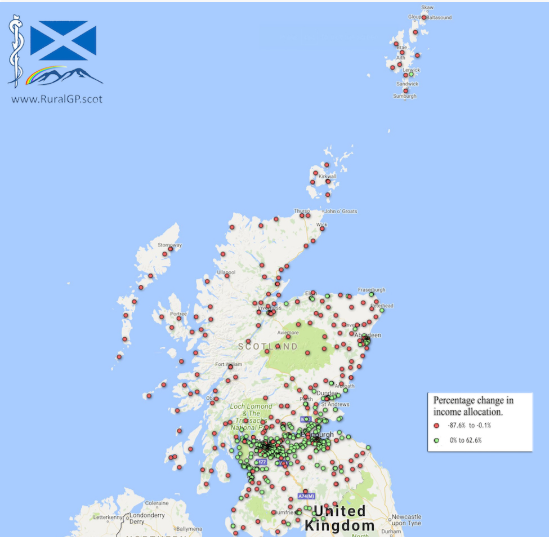
While no practice in Scotland will receive less money initially, the Scottish Allocation Formula makes it clear that some practices are more deserving than others. In rural practices and in ‘deep end’ practices, there is little in the way of hope of an uplift. The formula does not  recognise adequately the additional costs of running a rural service, the cost of addressing the health needs of rural poverty, of fuel poverty, the personal health and financial cost of travel to care, or the additional costs of professional training and networking.

The striking map below illustrates where practices are getting an uplift in funding in green dots. It was put together by Dr G Wheeler, North Uist Medical Practice, from data from the Scottish Government. (5)

the right map

At the same time, the impact of other policies is still being felt. Scotland’s broadband and mobile phone networks were designed to reach the majority, rather than the populations that needed them most. Even though broadband roll-out has been trumpeted widely, on the ground in rural areas, the infrastructure is incomplete. Rural practices still don’t have access to new data-collection systems, and wifi is still limiting participation from remote areas.

The new contract does not address rural health inequality and may be contributing to reduced retention. The allocation formula does not address the additional costs of providing health care in rural areas, the need to provide care to small and isolated populations all day every day, the need to provide realistic care in the case of widespread multimorbidity. If a multidisciplinary team is led by a GP now, expanding the team by adding fractions of WTE staff to many practices, makes co-ordinating that team more complex, without solving the recruitment needs.

The new contract in rural areas might mean many more clinical staff each offering only a tenth of a whole time equivalent each, never meeting to form a team. Accommodation for small rural teams doesn’t include space for expanded teams, and there seems to be no plan to address this.

The new contract does not seem to address deep-end health inequality either; their patients suffer from multimorbidity at an earlier age, before funding catches up. Their barriers to engagement and access may be societal rather than geographical, but poverty in both settings makes it harder to overcome those barriers.

The new contract cannot be accommodated easily in rural practice, and many practices feel they stand to lose much of the work that they held in highest value, the ability to go further to address clinical need and provide patient centred care in patients’ own homes and communities.

CONCLUSION

Addressing health inequalities in Remote and Rural, and in Deep-end practices should not be an afterthought. Bolting on solutions after the fact doesn’t seem secure. Is Rural Health Care really an additional extra?

Health policy should address the needs of the most vulnerable people in our country. Addressing the challenges first means that provision is fit for all, not just for the central belt. This ‘Rural First, Deep-end first’ approach is appropriate in many ways, from consultation, to creating policy and developing infrastructure.

Consultation for hard-to-reach areas needs to be more enquiring, more inclusive, more investigative. Relying on representatives means that only the views of a politically minded few are heard. Most GPs are in the service to provide health care, and as our ranks are depleted, fewer and fewer find time to get engaged in political lobbying and research.

Scotland sets itself out as a country where the Government listens to GPs, a country where it is the best place in Britain to be a GP. For those GPs who are working in the poorest, most deprived, most rural, most remote areas, these aspirations are not yet being met. Whatever we set out for the people of Scotland, it should work as well for the people of Barra, as for Barrhead and Bearsden.

REFERENCES:

  1. http://www.gov.scot/Publications/2018/03/6040/5 (accessed 06.06.2018)
  2. http://www.gov.scot/Publications/2011/09/29133747/2 (accessed 06.06.2018)
  3. http://www.gov.scot/Publications/2018/04/4249/0 (accessed 06.06.2018)
  4. https://www.eas.org.uk/en/fuel-poverty-overview_50439/ (accessed 14.10.2018)
  5. http://ruralgp.com/2017/12/mapping-out-the-proposed-scottish-gpcontract-allocation-formula/ (Accessed 15/10/2018)

A mini-inventory

I’m still pondering on who should be involved in this adventure, what exactly we are trying to achieve, and how. In the meantime, every day, something happens that reveals a new dimension, new ideas to try and new resources to explore.

Before I start changing everything, I thought I should do an inventory of what we do in our practice to support patients to be ready for a dialogue about their choices. Here is my photo-inventory.

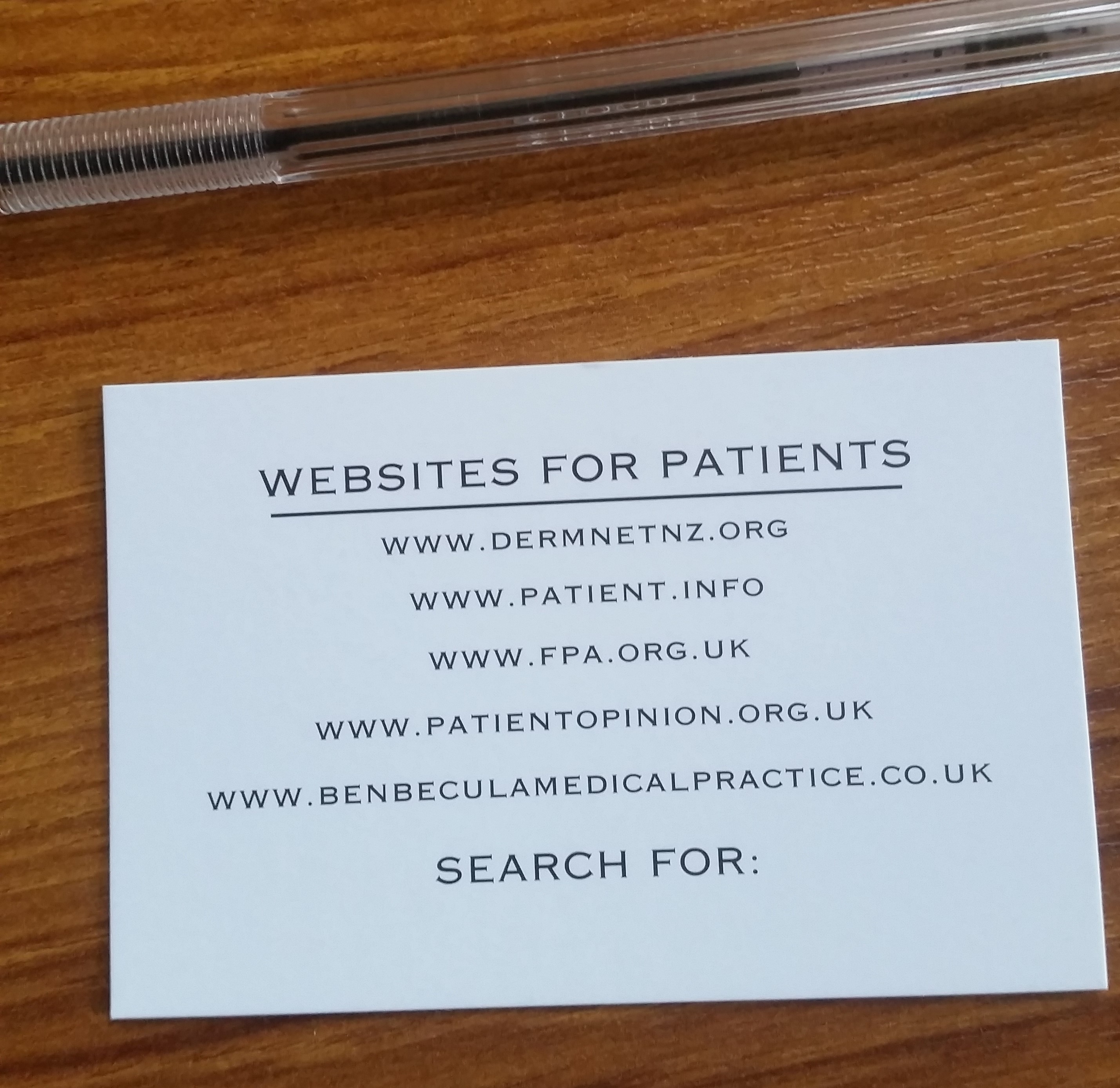
  1. Signposting cards. I have used these for a while, and then recruited them into a project to reduce the time patients wait in the surgery for their appointment. I give them to patients to look things up after the consultation. On the back, there is space for recording the next appointment. I could add the ‘five questions’. 2018-09-18 08.56.28
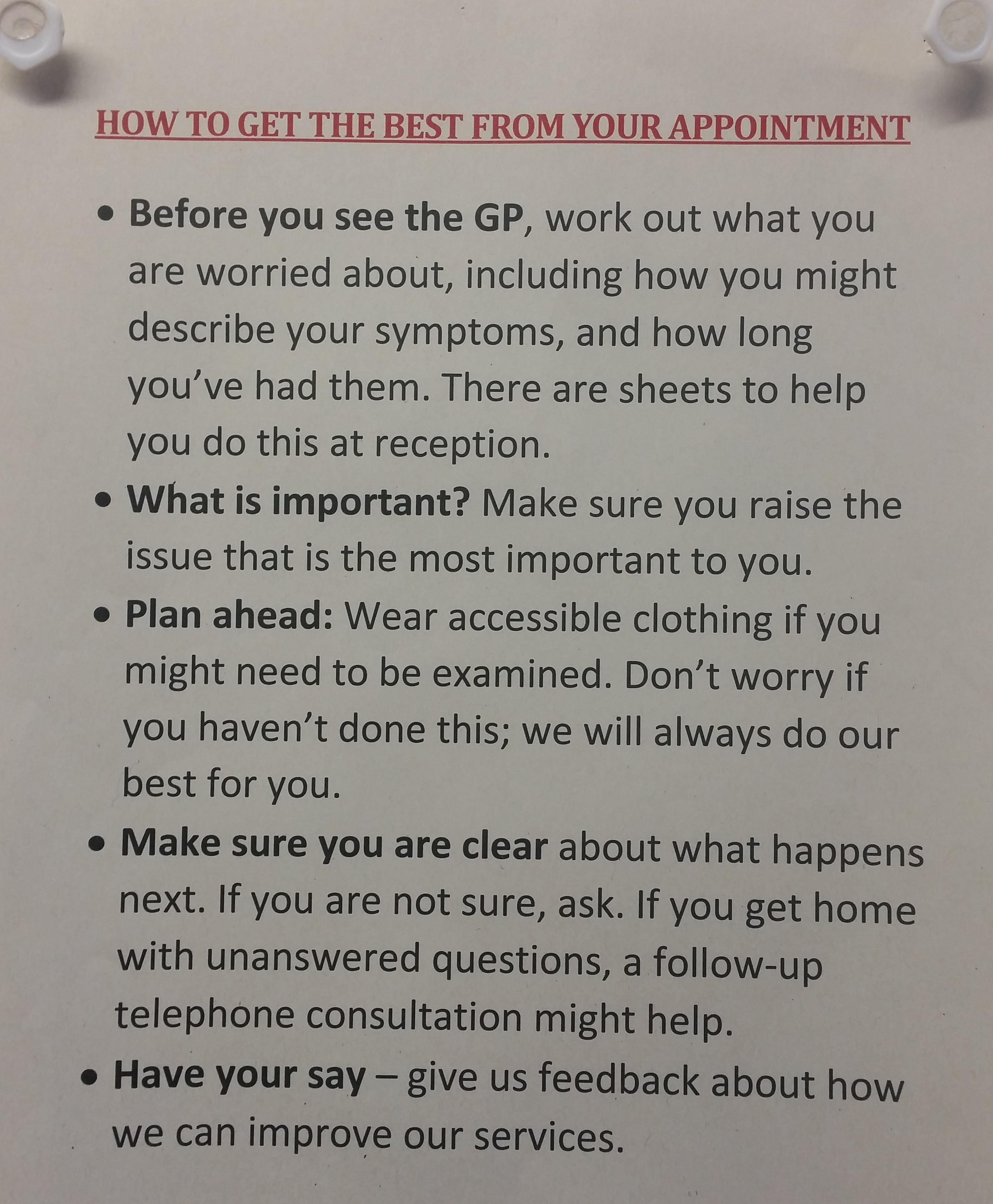
  2. Pre-consultation leaflets: part of the same project was to see if patients could be supported to make the most of their appointment. This seemed a brilliant idea, but patients are only be persuaded to use the forms if they were pressed upon them by the admin staff. The posters in the waiting room are still there, and the forms are at reception.2018-09-18 08.54.59
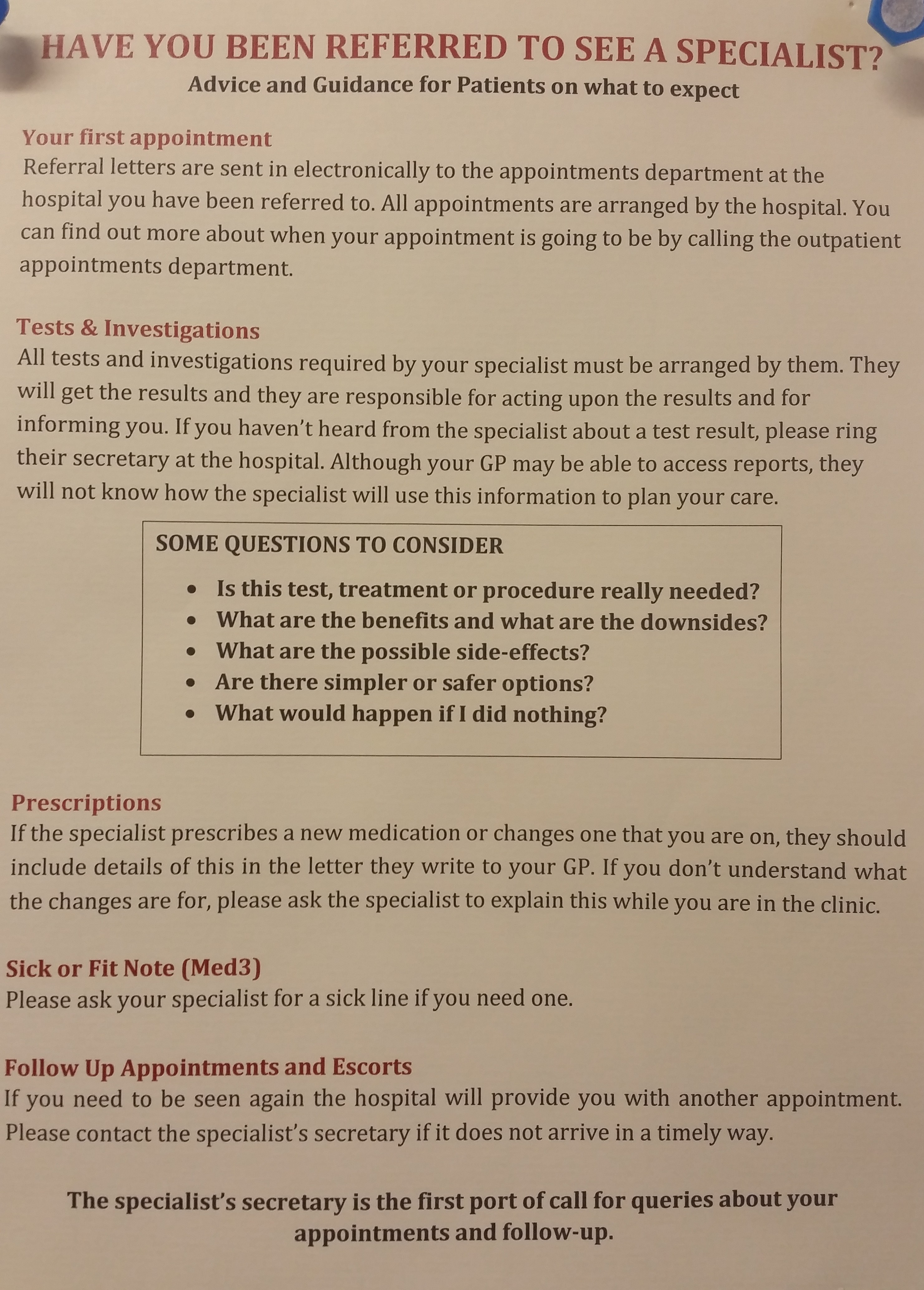
  3. We have also tried to direct people to contact the right person for queries about referrals, appointments and investigations, and to get the best from their hospital appointments. We should really do a proper interface project, but most of the consultants visit from out-of-the area, so that hasn’t taken off yet. However, the poster already has the ‘five questions’.2018-09-18-08-54-52.jpg
  4. We have also supported our practice population to attend workshops run by the Scottish Health Council to empower them to speak up about what matters. 2018-09-18 08.55.27

So, for the quick look round the surgery, we have some solid foundations. We also have a patient participation group facebook page and a practice website.

I strongly believe that people,our patients,  are a under-used resource for revolutionising health care. Enpowering them to spread the concepts of Realistic Medicine, they will spread through our health and care systems, asking for change, reaching the cynics as well as the enthusiasts.