What is patient-centred care?

What do we mean by patient-centred care? This isn’t a trick question but an attempt to reach a consensual answer.

A common response is that it’s about placing the patient at the centre of the care process, and seeking to address what matters to them, akin to a tailor made suit, rather than using a ‘one size fits all’ approach.

Some definitions focus on the responsibility of health professionals to inform patients about their healthcare and give them a choice. It could be more than this, with patient-centred care being about the partnership between practitioner and patient, with this relationship rooted in sharing power, rather than upholding a paternalistic attitude.

It does not mean doing everything that a patient asks; it is not ‘patient centred’ to give out diazepam and opiates without restriction when the consequence can be a hard-to-manage addiction. Being patient centred in this scenario might include a discussion about the reasons for a request, negotiating and sticking to a management plan, arranging additional psychiatric support, or a number of other options.

Patient centred care is also about designing services that meet the needs of patients rather than the needs of the organisation. This implies that the public should participate in the planning and redesign of services, and the reshaping of policy.

There are pitfalls. One commentator points out: ‘Three proposals topped a poll of options for reform at the ‘listening exercise’ attended by more than 1,000 people in Birmingham: extending GP opening hours, annual health MOTs and more walk-in centres. This familiar list of the preoccupations of the professional middle classes confirms the way in which this focus group approach places the demands of the worried well over those of the seriously ill (or even of the not very well, but socially marginal).

‘Listening exercises’ tend not to include those who are ill, particularly the elderly, children, people with mental illness or learning disabilities, families with young children, those who are not fluent in English – in fact, the majority of our patients and certainly those patients most in need of healthcare services. These proposals will increase costs out of all proportion to benefits and are likely to disrupt continuity of care for those patients for whom this is the most important aspect of primary care services.’

The concept of patient-centred care encompasses all of the above – from the organisational, redesigning services end of the patient-centred care spectrum through to the individual interactions side. However, health professionals, educationalists, managers and patient representatives are all developing different meanings that reflect their own history and position. Without a consensus about patient-centred care, it is hard to see how we can agree on how to deliver it. 

Being patient centred does not just mean responding to the demands of a vocal few. It is also about providing accessible, reliable care to the sick, the sad, and the frequent attenders, and treating all patients with common decency.

How do you weigh up medical advice?

I’ve been visiting family and friends, and as often happens, we compare medical notes. How easy is it to visit your GP? Who has the worst osteoarthritis? What medication have each of us been prescribed for high blood pressure? All of our social networks and norms are in play. Our family has a tendency to regard illness as a weakness,, and any visit to the GP involves careful callibration against the family norms.

One sister prefers to seek alternative solutions, changing her diet, drinking apple cider vinegar for her joints, and doing yoga. Another does not vist her GP or look for health issues on the internet, but pursues a very healthy lifestyle. My brother has sought private advice, my mother has checked with multiple medically-qualified relatives and friends. My dear dead dad used to boast about the top specialists he used to see, but would check in with me to see if I had heard of them, for validation.

Ever since I started medical school, I have been a sounding board for all sorts of friends and relatives, even before I had started my clinical years. In recent years, this has increased in frequency, and I have been wondering about this. Do people trust their GP and other qualified health professionals less? We can check everything on the internet, but sometimes that information is unreliable.

There are a number of factors in play. First of all, access to the internet has been growing over the last twenty five years. Artificial intelligence means that search engines can prioritise and summarise information quickly, no appointment required, any time and anywhere. Official sources of information such as NHSinform and patient.info can be a boon to health professionals, who can signpost to them for a modern take on the information leaflets we used to stock, and more likely to be up-to-date. Specialist websites provide a sense of community and support for conditions such as diabetes or muscular dystrophy. However, reliance on digital support for healthcare marginalises some groups. Statistically, older women are the least likely to be IT literate or to trust digital solutions, but low income, deprivation, language and cultural barriers are all in play. The affluent, urban, busy professional has become the target audience.

As a health professional, when I speak to a patient with high levels of understanding of their condition, and good health literacy, this is both a blessing and a stress. The fully engaged patient can participate in discussions about various health care options, can evaluate information, and challenge my own assumptions and knowledge base. This same group of patients may defer decisions so that they can evaluate and research their health questions further. It can be time consuming and intense, and of great value to the patient.

The second factor is less tangible than reliable information. It is trust. In our modern NHS, there are fewer GPs per head of population. At the same time, an older and less healthy population requires more health care. I could expand at length about the reasons for the reduction in whole-time equivalent GPs, but that is for another day. The upshot is that it has become harder to get an appointment with a GP and harder to see a GP that you have seen before. Continuity of care is disappearing, a loss to GPs and patients alike.

I polled a group of friends and relatives where they sought healthcare advice. The general approach seems to be to consider what issue to address, then to speak to friends and relatives first, perhaps supplemented by google. Only about half of these discussions led to a GP being involved at all, and any outcomes were further reviewed with relatives and friends. Clinically trained relatives, and those with the same condition, were the favoured sources of advice and discussion.

I asked these same friends and relatives about whether they usually saw the same GP, and whether they trusted their GPs. None of them could say who their GP was, or saw the same GP each time. Only half of them said they trusted their GP. I will quote one perspicacious reply:

How telling. The erosion of continuity of care has eroded trust and understanding, nuance and personalised medicine. Increasingly available and more complex information makes it harder to discriminate and evaluate the reliability of the information, how much weight to give it and whether it applies. Without trust from a wise navigator, where is realistic medicine? How do people without a clinically qualified relative cope? If General Practice has been reduced to a ‘painting by numbers’ service, how can personalised choices be considered?

What is ‘Realistic Medicine’ ?

All around the world, health care systems are talking about realistic medicine in some form or another. The words are not the same, but there is a common theme. In Canada, and in the UK, the movement is called ‘Choosing Wisely’ and in Wales, the conversation is about ‘Prudent Healthcare’. The ‘Choosing Wisely’ movement started in 2012, and is now internationally relevent, with over thirty countries and eighty specialist organisations engaged in the initiative.

At the heart of this new era in modern health care is the key idea that, just because we can do something, doesn’t mean it is right, ethical or reasonable to do it. Moreover, the goals of care for any particular patient should be the key priority against which any course of action should be measured.

Patients need trusted information that helps them understand that more care, more technical and intensive investigations and treatments are not always better. Some tests and treatments do not necessarily lead to improved health, or achieve what matters to them.

A patient’s tale. Mr M is a fictional patient on a remote island in the Hebrides. He is 84 and lives in the home he was brought up in. He is quite lonely; many of his generation have died in recent years, and surviving friends are generally not fit to drive, in residential care or in poor health. He has advanced prostate cancer, chronic kidney disease and poor mobility due to painful osteoarthritis. He is frightened of dying away from his people. When he develops urosepsis, he is admitted to the community hospital a few miles away.

Should he be flown by air ambulance to a bigger hospital where he can be treated with gentamicin, and cared for in a high dependency unit? This level of care cannot be provided in the community hospital. Or should he be managed by a GP without gentamicin?

Mr M’s goal is not to leave the island for health care, as he would prefer to die locally, so the decisions about care are about meeting this goal. The GP, the lead nurse and Mr M discuss his goals, and then the risks and benefits of treatment options. He survives this infection, and his goals are recorded in his clinical record. He is relieved that his fears are acknowledged and heeded, and he feels supported in his decision.

This movement requires excellent communication with patients and the public, so that they can be fully engaged in decisions about their care, and empowered to set the goals of that care. These conversations can be intense, personal and emotional, if they are to be really meaningful.

This does not just change individual discussions between one clinican and a patient, it informs the mindset of the whole healthcare system. Public involvement in this discussion is growing. Some national consumer groups, patient organisations and disease-specific groups are adopting these ideas, so that patients feel empowered to begin the conversation with their clinicians.

Realistic medicine should be a core part of health literacy, whatever you call it. As equal partners, doctors and patients can both ask for and engage in these conversations, however intense they are, because they are a fundamental part of providing good health care.

Words that disempower patients

Linguistic determinism is a concept that says that the language you use shapes the way that you think. The words we choose can change the way we limit and frame understanding, knowledge and ideas, and alter memory, categorisation, and perception. It is no surprise, then, that it affects the relationship between doctors and patients.

I have kept an article from the British Medical Journal from April 2022 to reread. It discusses the use of medical language. The authors state that the medical profession, in using elitist and outdated language, ‘casts doubt, belittles or blames patients, and jeopardises the therapeutic relationship…’

Using language in a way that disempowers patients is endemic. I’m sure, as a younger doctor, and copying the phrases of my senior colleagues, it helped me overcome imposter syndrome. This sort of language is pervasive, and using it makes you ‘one of the team’.

One example describes the situation where the clinician is struggling to make sense of the patient’s story within the clinician’s attention span. The patient is described as being ‘a poor historian’ when their narrative account of their symptoms does not meet the expectations of the clinician. It is the clinician’s duty to listen, to understand their story, concerns and expectations. Our skill as doctors, nurses, or other health professionals, is to ask the right questions, to listen carefully and to recount the clinical history accurately.

Other examples, with alternative words:

  • Presenting complaint – reason for attendance – ‘complain’ has negative connotations.
  • Ceiling of care – goals of care – ‘ceiling’ implies a limit to the treatment on offer.
  • Not compliant – this phrase is used when the patient did not follow instructions, but there is usually no mention as to whether the patient had agreed to the initial plan. We could write ‘barriers to adherence include …’
  • Did not attend – barriers to attendance – some patients really struggle with transport, mental health, organisational skills; by identifying the barriers, we can help patients access care.
  • Patient claims – patient reports – ‘claim’ implies that the patient is not being truthful.
  • Patient denies – patient did not experience – ‘deny’ implies a lack of truthfulness, of withholding information.
  • Patient refused – patient declined
  • ‘Has the patient been consented?’ – in this example, the patient is a passive recipient of information, no record of what the patient has understood and retained about a procedure.
  • Substance abuse – has a substance use disorder – the first phrase is associated with patient blame.

Patients can report feeling child-like in clinical settings. For example in a diabetic setting, blood sugars can be ‘good’; does the opposite imply that the patient has been naughty and bad? Some patients recount feeling as if they have been scolded for their poor outcomes, or ‘treatment failure’.

Every so often, I come across another phrase that is part of routine clinical discussion, and discover a more human, collaborative way of putting my view across. I hope to find ways of validating the patient experience, and allowing patients the opportunity to collaborate in creating their care plans.

The key messages from the article:

  • Some commonly used language in healthcare characterises patients as petulant, passive, or blames them for poor outcomes.
  • Such language negatively affects patient-provider relationships and is outdated.
  • Clinicians should consider how their language affects attitudes and change as necessary.
  • Changing our language to improve trust and support shared decision-making is unlikely to harm patients.
  • Better use of language may help us to reach more patient-centred and realistic care plans.

Linguistic determinism https://en.wikipedia.org/wiki/Linguistic_determinism – The concept that language and grammar affect the way we limit and frame understanding, knowledge and thought, for example, memory, categorisation, and perception.

The article by Caitríona Cox and Zoë Fritz was published in the BMJ on 30th April 2022, (you can read it here: https://www.bmj.com/content/377/bmj-2021-066720)

Realistic medicine saves the planet? Sustainability, environment and health

I am Dr Kate Dawson, one of the GPs at Benbecula Medical Practice in the Outer Hebrides. I have been working here since 1990, with three short breaks to complete some training, and when I had my babies, who are now grown up. We are lucky to live in a beautiful and precious place, which is generally safe and kind. I love gardening, knitting, and observing our wildlife when I am out walking.


Our islands, though, are very vulnerable to change. Global warming is bringing unpredictable weather, and rising sea levels will change our coastlines. It is getting more difficult to recruit staff, and travel links are not as good as they were a few years ago.


In the face of this, I have been considering the sustainability of the healthcare system that I am part of, and how we can make positive changes that will help our patients achieve better health, and at the same time, reducing our impact on resources. I dived in to think about this in more detail in the last year and found more than I thought possible.


What does sustainability and the environment mean in terms of health care? Here are some of the ideas that may affect patients directly. Some items will not surprise you, others might.

  • Patient transport. This includes trying to use active transport such as walking and cycling, using electric bikes and electric cars. This can be hard when distances are long, and our roads are narrow. However, this also includes trying to avoid travel to appointments when a phone call or video link would be as effective.
  • Waste management: Unused medication should be returned to the surgery for safe disposal, so it does not cause environmental contamination. You can also help by only ordering what you need when ordering repeat prescriptions. Empty inhalers and insulin pens should be returned to the surgery. Incinerating empty inhalers causes less damage than the gas in the inhaler being left in the environment.
  • Better prescribing: As an example, inhalers have a particularly detrimental effect on the environment. One MDI inhaler is as damaging as a drive to Inverness, whereas one breath-activated inhaler is equivalent of a drive between Griminish and Balivanich. Unnecessary and ineffective medication is a waste too. Don’t cut down on your inhalers, get advice about managing your asthma more effectively, use your preventer more, and ask to try a switch to breath activated inhalers.
  • Better decisions: Better discussions about treatment and referral help patients and doctors make better decisions. If you are referred for a treatment that you Don’t really want, or which may not benefit you much, then it is far better to discuss this before the travel, prescribing, tests and worry begin. It begins with talking frankly to your GP about the benefits, risks, and alternatives to the proposed treatment, and to ask what would happen if you did not seek treatment. Take someone with you if you need support with these discussions.
  • Good health is more than medication: Our current medical model from the twentieth century has been about patients coming to the doctors, their ailments quickly assessed, and a treatment or procedure prescribed. With authoritarian health care, the patient can become a passive recipient of medical care, and every ailment is met with a treatment or a procedure. There may be another healthier, less wasteful, more sustainable way.

Imagine this; you can improve your appearance, reduce your need for medication, your reliance on health care, improve your energy levels and joy in life, the benefits will last for years, and the cost is minimal. I am really excited with the possibilities. What is the secret? What if everyone could do this, it would reduce reliance on health care resources, and we would live to enjoy health into our retirement. I am talking about improving health by improving fitness.


As an example, the most cost-effective treatments for Chronic Airways Disease (COPD) are physical activity, smoking cessation, and flu immunisation. These three things are associated with better outcomes than any inhaler or medication.


I am using the word ‘fitness’ for a good reason, as it covers lots of concepts. It does not focus specifically on weight, or exercise, or smoking, or alcohol. It just focuses on being healthier. Where should you start? The beginning is to think about what you want to improve, to imagine what your goal is, what is driving you to consider making a change. Give yourself permission to write down or say aloud what you want to change, what could be better. Perhaps you want to be less short of breath, or your knees to hurt less, or to feel less lonely. Your goal will inspire you to keep trying. You could list all the things you might want to change and work out what you need to do for each thing.


Don’t try to change everything all at once. It is better to focus on one easy thing at a time and make it about fitness and fun. This year, for example, I plan to go for a walk at least once a week. If I miss a week, I have given myself permission to try again the next week, and not to give up when I fail. Last year, we started using smaller plates to reduce our portion sizes without cutting out our favourite foods. You Don’t need Lycra, or to run, or to go on an extreme diet, just find one thing that you can do, that you can enjoy, and make that into a habit that you can sustain.


Who are your allies? Have you got a trusted friend to talk to? A professional such as a physiotherapist, counsellor, nurse, or doctor could listen and support you, if you asked for this; the most important thing is to find someone who can listen to you. They may help you work out what you might be able to do next, to identify one thing that you can do easily, and to support you too.
Your one change may bring more benefits than you think. Going for a short walk will improve your fitness, and it will also raise your mood, reduce isolation, and ease joint pain. Meeting up with someone else for an activity such as knitting or singing will improve your mental agility, and will also reduce isolation, low mood, and loneliness.


As you start to improve your health, you may inspire others. We could have a new normal, in which we support each other to take steps to improve our health through simple changes to our lifestyles, reducing our reliance on medication and leading more fulfilling and joyful lives. We can help the environment and the NHS stay sustainable by creating our own better health.


For ideas, why not listen to Michael Mosley’s podcast ‘just one thing’ on BBC sounds.
https://www.bbc.co.uk/programmes/p09by3yy/episodes/downloads

Patient safety and co-production, from the BMJ

I was very excited when I read about this study, about improving inpatient safety by systematically improving communication with patients and families during ward rounds. I could see immediately how this could be transferable to our own setting in the community hospital.

The entry in the paper BMJ is quite short and humble, and it is worth visiting the online version for more detail, and to see the short video clip introducing the key researchers, who describe the design and outline of the project.

https://www.bmj.com/content/363/bmj.k4764

Structured ward rounds aren’t new, and neither is the concept of ‘no decision about me without me’. No-one would deny that families are an important part of the team providing care to patients. Using a structured communication tool has been embedded in our practice for many years. Teach-back is an excellent way of ensuring that the person receiving information has truly understood. The genius idea was to do all these things as a single process, and designing the intervention with service users.


The lead researchers are from the Children’s Hospital in Boston, Harvard Medical School, Mothers against Medical Error, and the Patient-Centred Outcomes Research Institute. They set out to introduce a method of improving communication with families. Their theory that this would improve outcomes was based on the observation that improving communication between clinicians improves safety, and that poor commmunication is a leading cause of adverse events.

The study group was made up of over 100 people, patients, nurses, family members, doctors, health literacy experts, researchers and medical educators. They co-produced the structured ward-round tool, to be used on ward rounds where the family is present. The communication tool is called I-PASS. They also produced a training package and a range of support tools including patient information leaflets.


A word about communication tools: We use SBAR locally, whereas I-PASS is the tool used in the study. It is designed to be used for structured communication with patients and families. It focuses more on the recommendations, and adds synthesis and teach-back as part of the communication tool.

I–Illness severity (family reports if child was better, worse, or same); nurse input solicited
P–Patient summary (brief summary of patient presentation, overnight events, plan)
A–Action list (to-dos for day)
S–Situation awareness and contingency planning (what family and staff should look out for and what might happen)
S–Synthesis by receiver (family reads back key points of plan for day, prompted by presenter, supported by others as needed)


The measures used were:

  • Outcome measure: Looking at error rates, and harmful errors
  • Outcome measure: Patient and family satisfaction
  • Balancing measure: Length of ward round
  • Balancing measure: Amount of teaching on ward round.
  • Process measure: Communication processes on ward round.

Although overall error rates were unchanged, harmful medical errors decreased and Satisfaction scores rose and communication processes improved. There was no significant impact on ward round length or teaching on ward rounds.

My own experience over the years has been that I have shifted from asking family members to leave the room during rounds, to asking if they can stay. The conversations around progress and plans for care involve families and patients equally. Bringing in students adds a dimension of teaching, usually in patient-centred language, and it enriches the discussion. These conversations lead to patient-centred decisions, which are understood by relatives as well as the patients.

In the words of Helen Haskell, president of Mothers against Medical Error, one of the lead researchers, ‘It doesn’t just feel good, it can help improve the safety and quality of care – I would add, improve health literacy, agency and opportunity for realistic, patient centred care to be forefront of care planning. This study is a model of how families and care provides can co-produce an intervention to make care safer and better.’

And more realistic.


The five questions: what are they, and do they matter?

capture

In the most recent annual report from the Chief Medical Officer for Scotland, Dr Calderwood discusses the need to move towards a shared approach to clinical decision-making. Are we not already doing this? The evidence says not.

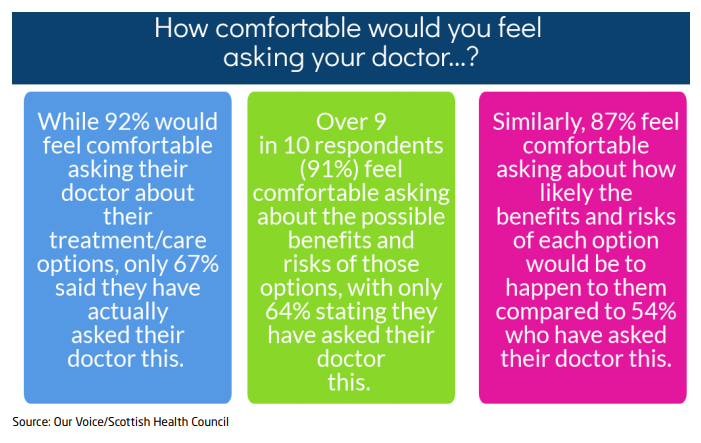
NHS surveys tell us that patients value highly the opportunities to discuss their care, the options open to them, and being involved in the decisions that shape their management. A survey undertaken by the Citizens’ Panel showed that while 92% of patients felt comfortable about asking their doctor about treatment, only 67% did so. Similar percentages were recorded for discussing risks and benefits. Why is there a gap? Patients report that the willingness of doctors, of how busy they appear to be, inhibit these discussions.

three talk

If we are to change our culture further (and it has already changed over the last fifty years) then we need to focus on how we enable these conversations. How often do we interrupt patients when they are talking? As well as restricting their narrative, it limits their expression of what is of concern. It emphasisis the agenda of the clinician and the pressures on their time. This needs to be more than tokenism, we need to really dig deep and learn better ways to do this. Having a good framework in which to conceptualise these conversations is important. One such structure is the three talk model. 

I also think that, as well as listening, and leaving space for debate and questions about management, we can coach patients to ask for better information. Some of this confidence comes from health literacy. Some comes from having the right words, the right questions to ask of clinicians as they leave our primary care consulting rooms and are passed on to secondary care colleagues, to other clinical teams.

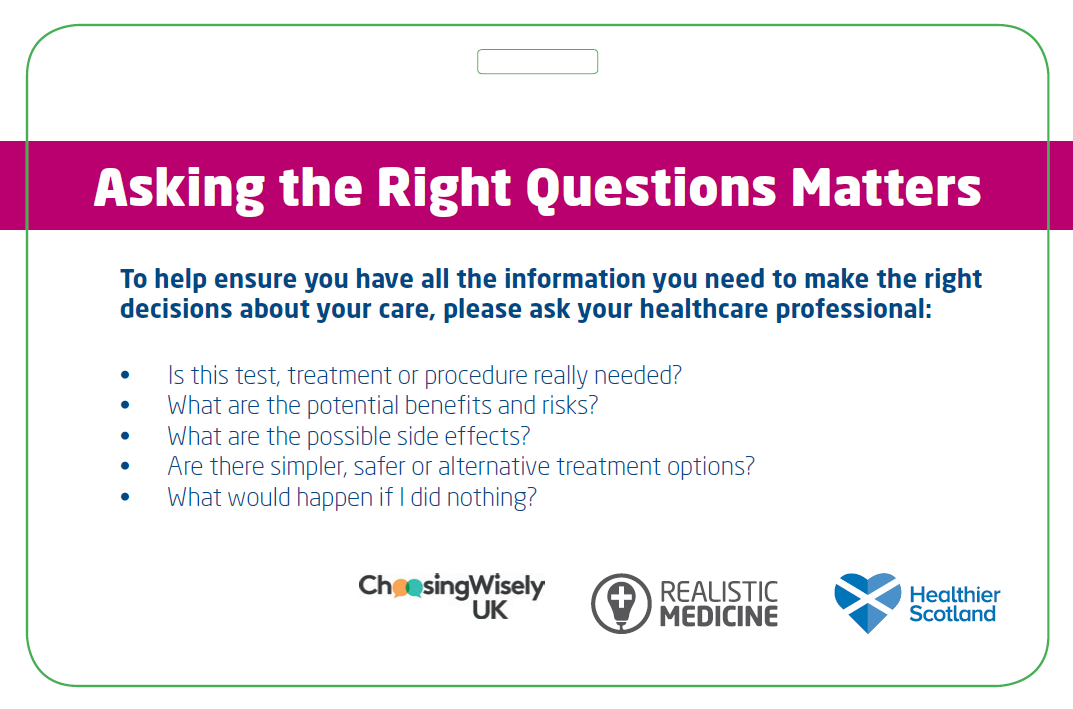
This is where the five questions come in. The five questions were drafted by Choosing Wisely UK, which is part of global initiative to improve conversations between patients and their clinicians.  Five boards piloted the use of the five questions, encouraging people to ask clinicians about their management plans. Having the questions written down enables patients to take first steps in these discussions. The questions aren’t going to change the world, but they can empower patients to start these important conversations.

I have displayed these questions in practice leaflets, on the noticeboard in the waiting room, on lanyard cards, on signposting cards and on the practice website. I don’t know how well I would do with answering all of the questions all of the time. However, as well as providing concrete examples for patients, this produces an environment, a culture where patients are expected to discuss their care. This message is as powerful for my colleagiues as it is for patients.

A wise friend of mine, Dr Maria Duffy, commented that these questions appear very clinically orientated. They do not explicitly promote discussions around the social determinants of health. She works in Pollok and is a GP trainer as well as a GP partner. She is part of the Deep End group, practices who look after patients in more deprived areas, where there are higher proportions of patients whose social and economic background has a big influence on their health.

She would add:

  • Is going to the doctor the best way to address my problems?
  • What is there that I might change myself that would help?
  • How much do I expect to achieve by seeking a clinical solution?

While these questions do not focus on a shared approach to clinical decision-making, they encourage patients and clinicians to think outside the clinical box, to imagine other ways of tackling life’s problems.

However, it is not enough to parachute in to our surgery with the cards and the posters. The most important next step for me is to ensure that my colleagues understand the scope of what I am doing, that patients are engaged in the project, and that any practical top tips are spread to other clinical areas.

Link workers and Realistic Medicine

My last post was a poem that really struck me. I’ve been wondering why, and I think it was because it articulates the need for help to be practical, to be real, and to have relevance and credibility for the person accessing that help. Just wanting to help, wanting to be useful, is not the full story.

What attributes would an effective link worker have? They’d have to be comfortable around people, good at connecting with professionals, community groups, officialdom and patients. They’d be able to gain trust, and then walk alongside people who may be disempowered in the face of the clinical professions, enabling communication. They’d need to be enquiring, able to find out and keep in contact with key people within organisations, to understand how to get the best from them. They would be able to understand the needs of each person that they support, and advocate for those needs to be met.

What evidence do we have that individuals need this kind of support?

% who can ask

We know there is a gap, data tells us that even though patients tell us they could raise questions in a consultation, in reality, this doesn’t always happen. For 10% of patients, they know they won’t ask if they don’t understand. For a further third, they think they could ask, but in reality they don’t. It is those with the least health literacy that need this support the most, otherwise realistic medicine is going to be beyond their grasp.

The new GP contract includes an aspiration for employing link workers so that every General Practice has access to a link worker, and that link worker can work with patients without need for a separate referral. It remains to be seen whether the people that need this support the most get the most access.

So, it seems to me that our link workers could be powerful allies for patients, decoding the language that is already building up around the concepts of Realistic Medicine, and keeping it basic, keeping it real, and keeping the patient at the heart of our consultations.

We don’t have a link worker identified in our area yet, but she or he will be on the project team.

Patients and quality in health care – co-production at scale.

If you type patients, quality and care into google, the results suggest that this is something that we do for and to patients. Discussions about change agents take me to pages about how to engage clinicians within the healthcare system, but nothing directly about patients as systematic change agents.

I want to flip this on it’s head, and inspire patients to shape the health service, seeking provision that meets what matters to them. A 180 degree revolution. Clearly, there needs to be some strategy, some oversight from health care providers, so that those with greatest need don’t lose out to those with the strongest lobby. Both parties are required to create the service.

The current term for this process is co-production. On a personal level, working as a GP, this is our bread-and-butter. An effective consultation supports the patient with diagnosis, providing information, management choices, and opportunities to meet again to discuss progress.

While I was looking for articles about patients as change agents, I came across the concept of the Patient Activation Measure, a tool to assess how ready patients were to engage in these discussions. The tool is used on an individual, case-by-case level, where the doctor-patient relationship and the problem to be managed is the scope of the co-production. How could we lift this to a more strategic level? Could we use the Patient Activation Measure to see how successful systemic change is in increasing the number of patients able to use the tools of realistic medicine, able to develop that agenda with the clinicians they meet?

As a GP partner in Scotland, I am responsible for ensuring that our practice systematically provides safe appropriate patient-centred care. We provide opportunities for patients to feed back to us about their experience of healthcare, and give us suggestions about improvements. These tend to be about small things – how comfortable our seating is, whether we should have Radio 2 or another station in the waiting area.

Nationally, Care Opinion collects patient feedback, enables organisations to respond and reply, as well as being searchable. But this doesn’t of itself, change the relationship between clinicians and the public. Much of the positive feedback includes stories about care where the principles of Realistic Medicine has been at the heart of care. Within this movement, I feel I am getting closer to system-wide patient-led quality improvement.

The place where I feel this project really sits is as part of the House of Care. I seem to be trying to create an environment in which the left-hand wall is nurtured. Imagine a house which has, at it’s centre, conversations about care, support, realistic medicine. The foundation and floor is the social context, all of the sources of support in a community. The roof, sheltering this all, is the system and processes that bring the patient and clinician together. The conversation has on one side, individuals ready to engage in a therapeutic dialogue, and on the other, clinicians who are committed to partnership working with patients.

House of care

So far, most of the Realistic Medicine discussions that I have been involved in have focused on the clinicians, the ‘right-hand wall’, and on the roof. However, we could possibly be talking only to each other, unless we have individuals and carers that are speaking the same language, individuals and carers who can start these conversations spontaneously.

This model allows for work at local, regional and national scale. The British Heart Foundation has just published a report on a three-year project that used the House of Care Model in five health communities. The report describes how patients were involved in championing this approach, how important an enabling infrastructure is, how to flex the model to fit local need, and the importance of culture before paperwork.

I’m feeling inspired.

References (accessed on 11/10/2018):


Who was Warner Slack?

Subtitle: Why communication technology matters.

I read last week’s BMJ obituaries, as I often do. (read the article HERE) The main tribute reflected on the work of Dr Warner Slack, who believed that ‘the patient is the largest and least utilised resource in healthcare’.

As I read further, I was astonished at the foresight of his vision. In the 1970s, with others, he set up the Center for Clinical Computing at Harvard, and created one of the earliest hospital information systems. He wrote much about clinicians and information technology, but the area I wish to focus on today is his vision of patient-clinician partnership, enabled by Information Technology.

Dr Slack trusted the agency of patients to use automation for their benefit decades ahead of his time. His underlying inspiration was that computing and information technology would empower clinicians and patients. He wrote about online patient communities, now a reality, with websites such as Patients like me and Smart Patients empowering patients to find out from others about the experience of their conditions, and the reality of treatment choices.

He also believed that patients should have access to their digital records, and now we have the OPEN NOTES movement.

I believe that patients need time to understand what we have told them, have the right to consider what we have recorded in their notes, and to consider the implications of their condition and the treatments that they are choosing between. This access, alongside health literacy, means that patients are on the therapeutic team for their own care.

I’ve had a look at the Primary Care Digital Services analysis of what we are working towards, and patient access to their clinical notes has been classified as High Input, Low Impact, meaning that it will be low down on the list of projects being progressed. I know that this is already part of the English GP contract, so it can be done.  This week’s mission: to find out whether this access is coming across Scotland, across the Western Isles, and on Benbecula.

Also, to link the blog to the practice website and the practice patient participation facebook page. (Done)

I’m inspired by Dr Slack, whose ideas are so relevant to Realising Realistic Medicine.