Indication prescribing

I’ve discovered a way of doing things that improves patients understanding of their medication, and it is so simple I can’t believe I didn’t always do it before.

Actually, I lie. I was already doing it sometimes, I just hadn’t named what I did, or thought about it.

When I prescribe paracetamol, it has been fairly normal for me to write ‘take two tablets four times a day for pain’. It is the same for most of the PRN medications I prescribe. However, for all routine medications, the directions say how, but not why to take the medication.

I changed that in 2019. When I review medications, I add the indication to the prescription. The whole practice including our attached pharmacist will start using this as the new standard. For Amlodipine, for example, the directions say ‘take one in the morning to lower blood pressure’. How simple it is to do that. We can program the new directions in as short-cuts too. We’ve not been completely reliable, but it is becoming a normal way of working.

Hopefully, this small step has added a smidge more information to patient-centred discussions and decisions about medication. Maybe a bit naive, some people will always take the four white tablets in the morning without question. Some other people will play a random game, like the woman who just put all her medication in a bowl like mint imperials, and took some every day.

Now, patients will have an easy opportunity to recall why they take their medication, as well has what that medication is. More information, better discussions, more patient-centred, realistic decisions.

A patient writes about participating in a clinical trial.

I was extremely fortunate that a chance comment about breathlessness to my GP following a walk up North Lee, quickly lead to some tests and a consultation with consultant cardiologist Dr. Stuart Watkins at the Golden Jubilee Hospital in Glasgow.

After a preliminary scan, I was diagnosed with restricted coronary arteries and required three stents, two of which were joined at a ‘Y’ shaped branch. This is a slightly more complicated procedure, and whilst he was explaining this to me, Dr. Watkins said that my case might be suitable to be included in a medical trial called ‘October’.

One’s first reaction when you have had a relatively serious medical diagnosis is that you just want to have the normal procedure as soon as possible and, in truth, the idea of being part of what sounds like a medical experiment is difficult to contemplate.  However, on a closer read through the information, and discussions with both my GP in person, and Dr. Watkins by phone, it was clear that the trial was not about a new type of stent or a new method of inserting them, but a different way of imaging the procedure as it was under way.  This new technology is believed to be particularly helpful in more complex Y branch stent procedures.  Thus reassured, I agreed to take part. 

When I arrived on the ward it felt a bit like being treated as a VIP.  Not only did I have all the normal high quality care and attention one would expect from the nursing staff, but I had a second nursing team working on the trial looking after me too!  The senior trial nurse explained to me that I was the first patient to be on the October trial at the Golden Jubilee, although many other patients had been involved in other similar trials using the new imaging technology all over the world.  Also that the trial was ‘randomised’, with patients being selected by a computer programme when the procedure was already under way.

Catheter labs are very busy high tech places with what seems to the patient to be masses of staff and equipment, and the trial adds to both staff and equipment so makes it even busier.  As the moment approached for the new imaging equipment to be turned on, the trial nurse started the randomising computer programme running, and a few seconds later she announced that I hadn’t been selected!  So my procedure was then finished in the normal way.  As soon as it was completed, Dr Watkins reassured me that because the arteries were at the front of my heart they were easily visible using the standard imaging technique anyway, and that he was very pleased with the results.

Afterwards, as I was patient ‘no 1’ on the trial, Dr Watkins and the senior trial nurse came to the ward and we had our photo taken for the hospital magazine.  The trial nurse contacts me every few months to check I’m OK and will do so yearly for the next 10 years.

My recovery was incredibly quick.  I was able to start taking short walks after a few days of taking it easy and headed up Rueval after around 6 weeks – accompanied by my District Nurse sister.  Then in the summer I walked up Eaval with our younger son Joe, feeling absolutely back to normal in terms of fitness.  Now I walk our dog twice a day for an hour and also go swimming once a week.

My recovery has been monitored by the Uist Cardiac Nurse and I’m just about to attend my final clinic.  She says I’m a model patient, but I take a different view.  In the Golden Jubilee ward I was surrounded by patients who had suffered much more serious cardiac problems, so I feel I’ve been incredibly fortunate to live on Uist and experience such fantastic medical care which has allowed me to return to my normal life.  I will always be grateful for this, and participating in the ‘October’ trial and hopefully benefiting medical science in a small way in the process, is as good a way as any of saying thank you.

At the top of Eaval in North Uist

Preparing for the Benbecula House of Care

We are preparing for a new way of working in our practice. The idea is that we take what we do, and we supercharge it. Some of it sounds quite obvious.

Take the review of chronic diseases. At the moment, patients get called in for a pre-appointment check, then come back to see the nurse practitioner for a review of their condition.

The change is quite simple and also completely revolutionary. After the pre-appointment check, the patient is sent an update on their health, including any important areas to discuss, and space for them to consider what the key issues are for them. When they come to meet the nurse practitioner, the patient gets to choose which aspect of their health is most important for review, and for choosing which goals to set for the year ahead.

One of the key steps is how we reframe the review appointments. I personally believe that this is crucial: if we as a practice don’t understand and embrace this step, then all of the other changes are not going to be fully effective. This is the goal, the inspiring change.

I was very pleased to come across an article in the British Journal of General Practice: Setting goals with patients living with multimorbidity. Even the title is great – the goals are set with the patients, and they are the ones who are living with multimorbidity. The full article is in depth, and qualitative. The authors analyised 10 hours of VC to determine how goal setting is done. They describe ‘bearing witness’ to the patients goals. They conclude that this process requires a lot of time and energy from both parties, and it worked best when both GP and patient were prepared in advance.

I’m keeping that summary in mind, both for when we attend our training in Harris, and for when I prepare the staff-room QI noticeboard.

Planning good health with patients

I’m just getting myself into the right frame of mind for the training we are going to do for our Benbecula House of Care project. I’ve also been stockpiling journals with articles that have caught my eye, and there has been a theme. Many of them are about empowering patients, and dealing with clinical complexity.

One of the articles stood out for me tonight. It discusses how we help patients lose weight. Much of the article covers change theory, identifying motivators for change, setting goals, signposting and support.

In the top right of the third page was the most interesting bit of all: a bubble diagram. How simple, how powerful, for the patient to set out what they wish to focus on.

Bubble diagrams can be used to help patients decide what to discuss. Blank bubbles allow people to tailor the topics to meet their own needs.

There are loads of bubble templates on the internet, in the shape of trees, or networks, beautifully designed and probably copywrited. But as you can see, a pen and paper and an open mind are fine.

The article? It was called ‘Top Tips: talking about weight’ published in Guidelines in Practice from February 2019.

A riff on continuity of care: How it helps to personalise realistic medicine and makes patients agents of improvement.

A year ago, I worked for three days in Pollok, at the Peat Road Medical Practice. I made a fairly amateur video of my experience, but the points I made at the end still feel really important.

I can still recall the faces of the patients that I saw in those three days, and wonder what happened to them. I didn’t have the luxury of reviewing them, of speaking to the wider team over time to see how they were doing. I wondered how it felt for them, not knowing who would see them next, or who would steer them through the system to better health.

I have the luxury of having worked in the same practice for over 25 years, and even if I don’t see a patient often, I know their back story, and if they want to see me, they know I’ll be there, and that I know the local health system intimately. This long-term relationship is based on trust and shared knowledge.

A systematic review of the impact of continuity of care was published in the BMJ last year, examining the link between continuity and health outcomes. It concluded that higher levels of continuity of care are associated with lower mortality rates, no matter the clinical system or cultural boundaries.

The articles that this analysis was based on were heterogeneous, and the authors comment on how hard it was to compare themes and outcomes. This said, I would like to have seen the article also discuss whether continuity of care has an impact on choice and management of risk. My own experience tells me that when the patient and I know and trust each other, I can take conversations further, and the patient is more able to tell me what they want from their care. Continuity of care can give us the freedom to decide to do nothing. It empowers patients to set their own health agenda.

My theory: Continuity of care promotes realistic medicine. It supports patient-centred discussions, and coaches patients into being the best advocates for their own health. On a large scale, it supports effective health care, and drives improvement by taking the needs of patients to design better systems.

Patient safety and co-production, from the BMJ

I was very excited when I read about this study, about improving inpatient safety by systematically improving communication with patients and families during ward rounds. I could see immediately how this could be transferable to our own setting in the community hospital.

The entry in the paper BMJ is quite short and humble, and it is worth visiting the online version for more detail, and to see the short video clip introducing the key researchers, who describe the design and outline of the project.

https://www.bmj.com/content/363/bmj.k4764

Structured ward rounds aren’t new, and neither is the concept of ‘no decision about me without me’. No-one would deny that families are an important part of the team providing care to patients. Using a structured communication tool has been embedded in our practice for many years. Teach-back is an excellent way of ensuring that the person receiving information has truly understood. The genius idea was to do all these things as a single process, and designing the intervention with service users.


The lead researchers are from the Children’s Hospital in Boston, Harvard Medical School, Mothers against Medical Error, and the Patient-Centred Outcomes Research Institute. They set out to introduce a method of improving communication with families. Their theory that this would improve outcomes was based on the observation that improving communication between clinicians improves safety, and that poor commmunication is a leading cause of adverse events.

The study group was made up of over 100 people, patients, nurses, family members, doctors, health literacy experts, researchers and medical educators. They co-produced the structured ward-round tool, to be used on ward rounds where the family is present. The communication tool is called I-PASS. They also produced a training package and a range of support tools including patient information leaflets.


A word about communication tools: We use SBAR locally, whereas I-PASS is the tool used in the study. It is designed to be used for structured communication with patients and families. It focuses more on the recommendations, and adds synthesis and teach-back as part of the communication tool.

I–Illness severity (family reports if child was better, worse, or same); nurse input solicited
P–Patient summary (brief summary of patient presentation, overnight events, plan)
A–Action list (to-dos for day)
S–Situation awareness and contingency planning (what family and staff should look out for and what might happen)
S–Synthesis by receiver (family reads back key points of plan for day, prompted by presenter, supported by others as needed)


The measures used were:

  • Outcome measure: Looking at error rates, and harmful errors
  • Outcome measure: Patient and family satisfaction
  • Balancing measure: Length of ward round
  • Balancing measure: Amount of teaching on ward round.
  • Process measure: Communication processes on ward round.

Although overall error rates were unchanged, harmful medical errors decreased and Satisfaction scores rose and communication processes improved. There was no significant impact on ward round length or teaching on ward rounds.

My own experience over the years has been that I have shifted from asking family members to leave the room during rounds, to asking if they can stay. The conversations around progress and plans for care involve families and patients equally. Bringing in students adds a dimension of teaching, usually in patient-centred language, and it enriches the discussion. These conversations lead to patient-centred decisions, which are understood by relatives as well as the patients.

In the words of Helen Haskell, president of Mothers against Medical Error, one of the lead researchers, ‘It doesn’t just feel good, it can help improve the safety and quality of care – I would add, improve health literacy, agency and opportunity for realistic, patient centred care to be forefront of care planning. This study is a model of how families and care provides can co-produce an intervention to make care safer and better.’
And more realistic.


Prevention of falls – co-producing safety at home.

I read the BMJ every week, and tag the articles that might influence my practice. This time, the article that caught my eye was about falls:
https://www.bmj.com/content/364/bmj.l880. The summary – assessment by an occupational therapist, and making your home safer works well in patients at high risk of falling.

We’ve all been there, talking to patients about their rugs, the hazardous route round the bed with all the slippers in the way. Patients like the way they live, and just handing out advice doesn’t always make a difference.

This article has a great wee box on the co-production of safety at home, how to make very real improvements. The language is quite technical, so I have paraphrased this below. I’m so excited about it that I may well make a waiting room display on the subject.

  • If you are 65 or older and live at home, your risk of falls in the future is higher if you’ve had a fall in the last year, use a mobility aid, need help with basic activities, take medications that might make you sleepy, or if you are worried about falling
  • An assessment of where you live by an occupational therapist could reduce your risk of falls
  • The assessment involves a visit from the occupational therapist, who will recommend changes to tasks and your environment. These suggestions aim to reduce hazards and improve your independence and safety.
  • The occupational therapist may also suggests gadgets and technology to improve your safety at home, such as an emergency buzzer.
  • Occupational therapists typically ask you to identify what you think puts you at risk of falling, and you jointly problem-solve and agree on solutions.

I love that last sentence.

Complications: Atul Gawande

This weekend’s reading has included this book. In fact, I haven’t read anything else. The last two chapters in particular explore the relationship between doctors, their patients, between patient autonomy and taking clinical responsibility.

Atul Gawande is a surgeon and writer based in Boston, Massachusetts. He has written several very popular books about the praactice of medicine, as well as delivering four Reith lectures for the BBC in 2014.

This is his first book, published in the UK in 2002. There are fourteen essays, grouped into three sections. The first deals with fallibility and error, and the second looks at the mystery of medicine.

The final four essays discuss how we manage uncertainty in medicine, the interface between clinical evidence and human decisions. The penultimate essay is entitled ‘Whose body is it anyway’. In this essay, he discusses some of the core issues of realistic medicine, fourteen years before Catherine Calderwood coined the phrase. In truth, consent and patient autonomy are not new, but having a banner under which to explore these themes has been powerful.

He discusses the gap between what patients want and what they hope for. His writing is straightforward, and his arguments are illustrated by cases, the stories that hook clinicians into the debate. He describes how honest clinical discussions allow patients to understand what is happening, and take their share in the decisions.

In his own words: ‘Just as there is an art to being a doctor, there is an art to being a patient. You must choose wisely when to submit and when to assert yourself. Even when patients decide not to decide they should still question their physicians and insist on explanations… You do the best you can, taking the measure of your doctors and nurses and your own situation, trying to be neither too passive nor too pushy for your own good.’

‘Where many ethicists go wrong it is in promoting patient autonomy as a kind of ultimate value in medicines rather than recognising it as one value amongst others. Schneider (The Practice of Autonomy) found that what patients want most from doctors isn’t autonomy per se; it’s competence and kindness. Now kindness will often involve respecting patient autonomy, assuring that they have control over vital decisions. But it may also mean taking on burdensome decisions when patients don’t want to make them, or guiding patients when they do.’

‘Even when patients do want to make their own decisions there are times when the compassionate thing to do is to press hard: to steer them to accept an operation or treatment that they fear or forgo one that they pinned their hopes on. Many ethicists find this line of reasoning disturbing, and medicine will continue to struggle with how patients and doctors ought to make decisions. But, as the field grows ever more complex and technological the real task isn’t to banish paternalism; the real task is to preserve kindness.’

The eternal balance between clinical evidence, being clear about outcomes and chance, giving patients the chance to influence the chances that they have and the treatments that they receive.


WHEN PATIENTS INVENT TO HELP THEMSELVES

It has been a long time since I blogged, but not for lack of ideas, more a deluge of concepts and ideas, combined with the ever-present day job.

Today, I read an article in the BMJ, (click here to read it yourself) and it has lit a slow fuse. The article is about the ultimate patient engagement, where individuals with a condition create solutions that revolutionise care. 

Patients really understand what it is like to live with their condition, to come to terms with how it will affect their living and their dying. Patients who have been given the opportunity to understand what their condition is, and how it will progress, patients who have time to focus on their own solutions, these are the people who are coming up with the solutions that healthcare industry had never considered. 

This is the ultimate patient engagement, where patients have found what is on offer doesn’t meet their needs, where the risks are unacceptable, or the outcomes just not good enough. The inventions covered include a new type of surgical prosthesis for aortic root problems in Marfan’s disease, a smart ileostomy bag that tells you when it needs attention, an app to self-manage repeat prescriptions and medication compliance, another IT solution that uses CBT to improve sleep, an physiotheraby device for hand rehabilitation. 

The people behind these innovations are all persistent, have really understood the issues they are trying to solve, and have been steadfast in their pursuit of developing and sharing their ideas for the good of people like themselves. For several, they comment that it has been a long, frustrating process. Tal Goldsworthy, the inventor of the aortic root device, comments ‘If I had known it was going to be this hard, I really wouldn’t have bothered’ – but never the less, he has devised a safer alternative to aortic root replacement, and 200 patients have been fitted with his device. 

What these innovaters have found in their paths to success has been a willing clinical supporter. In general, one of the key hooks is being able to show that the innovation makes for better care without adding complexity. The message – ‘if you are a doctor who believes in the technology, then two words are key: be brave’. It is so much easier not to do something, but with courage you can help technology to really grow’.

Patients have their own lives to enhance, and that is a powerful motivator, but we need to be there as clinicians to make new ideas work.  

The five questions: what are they, and do they matter?

capture

In the most recent annual report from the Chief Medical Officer for Scotland, Dr Calderwood discusses the need to move towards a shared approach to clinical decision-making. Are we not already doing this? The evidence says not.

NHS surveys tell us that patients value highly the opportunities to discuss their care, the options open to them, and being involved in the decisions that shape their management. A survey undertaken by the Citizens’ Panel showed that while 92% of patients felt comfortable about asking their doctor about treatment, only 67% did so. Similar percentages were recorded for discussing risks and benefits. Why is there a gap? Patients report that the willingness of doctors, of how busy they appear to be, inhibit these discussions.

three talk

If we are to change our culture further (and it has already changed over the last fifty years) then we need to focus on how we enable these conversations. How often do we interrupt patients when they are talking? As well as restricting their narrative, it limits their expression of what is of concern. It emphasisis the agenda of the clinician and the pressures on their time. This needs to be more than tokenism, we need to really dig deep and learn better ways to do this. Having a good framework in which to conceptualise these conversations is important. One such structure is the three talk model. 

I also think that, as well as listening, and leaving space for debate and questions about management, we can coach patients to ask for better information. Some of this confidence comes from health literacy. Some comes from having the right words, the right questions to ask of clinicians as they leave our primary care consulting rooms and are passed on to secondary care colleagues, to other clinical teams.

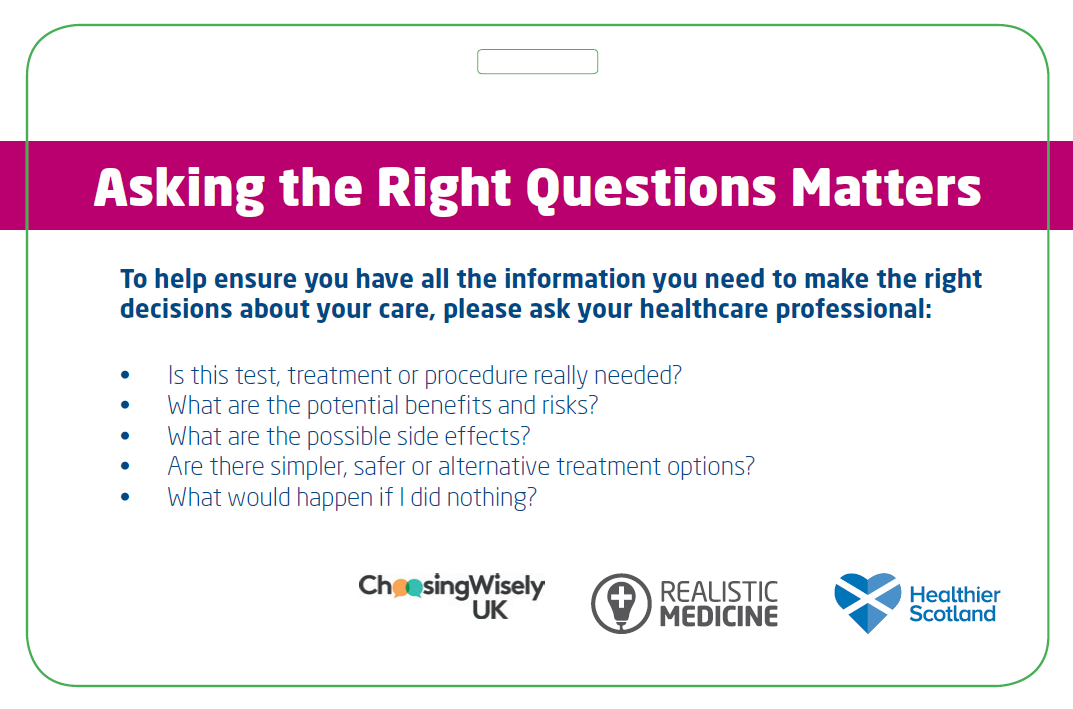
This is where the five questions come in. The five questions were drafted by Choosing Wisely UK, which is part of global initiative to improve conversations between patients and their clinicians.  Five boards piloted the use of the five questions, encouraging people to ask clinicians about their management plans. Having the questions written down enables patients to take first steps in these discussions. The questions aren’t going to change the world, but they can empower patients to start these important conversations.

I have displayed these questions in practice leaflets, on the noticeboard in the waiting room, on lanyard cards, on signposting cards and on the practice website. I don’t know how well I would do with answering all of the questions all of the time. However, as well as providing concrete examples for patients, this produces an environment, a culture where patients are expected to discuss their care. This message is as powerful for my colleagiues as it is for patients.

A wise friend of mine, Dr Maria Duffy, commented that these questions appear very clinically orientated. They do not explicitly promote discussions around the social determinants of health. She works in Pollok and is a GP trainer as well as a GP partner. She is part of the Deep End group, practices who look after patients in more deprived areas, where there are higher proportions of patients whose social and economic background has a big influence on their health.

She would add:

  • Is going to the doctor the best way to address my problems?
  • What is there that I might change myself that would help?
  • How much do I expect to achieve by seeking a clinical solution?

While these questions do not focus on a shared approach to clinical decision-making, they encourage patients and clinicians to think outside the clinical box, to imagine other ways of tackling life’s problems.

However, it is not enough to parachute in to our surgery with the cards and the posters. The most important next step for me is to ensure that my colleagues understand the scope of what I am doing, that patients are engaged in the project, and that any practical top tips are spread to other clinical areas.