Empowerment in Heart Failure: Lessons from Dr Launer

Dr John Launer is a retired GP and GP educator, and he has severe heart failure. Recently he wrote an article about his diagnosis, how he found out about his illness, and about the language and expectations around his condition.

He was informed that he had severe heart failure by a consultant standing at the end of his bed, surrounded by several people who were never introduced. There was no privacy, or discussion of hope, no context about the future and what that might hold. Even the words, ‘severe heart failure’ imply a loss of hope.

Dr Launer defies this image of himself. He still works almost full time, and is a keen long-distance walker. Patients with heart failure may live almost without symptoms, with the appropriate medicines and implanted devices. He calls on us all to see beyond the medical label and to look at patients and their potential. Clinicians could do better by informing people about their diagnoses in a way that empowers them to make their best decisions about their future health.

One of these decisions about health is about lifestyle. There are few conditions that are not improved by exercise, by eating well, eschewing smoking and alcohol, and good weight management. There is strong evidence that exercise has excellent benefits in the management of heart failure, including a reduced risk of hospitalisation and mortality, improved quality of life and enhanced exercise capacity. Check the British Heart Foundation page here for more information:

And so it is that Dr Launer walked a thousand miles around Wales, raising money on the way for ‘Pumping Marvellous‘, a heart failure charity. Don’t let your diagnosis define you, disempower you, or dishearten you.

Risky Business: Welcome to uncertainty

What is the risk that this treatment will harm you? Is there a chance that a test will give a misleading result, leading to a misdiagnosis? What is the likelihood that your new diagnosis will have a good or bad outcome?

The practice of medicine is full of the management of risk, and communicating risk. There is a whole annual conference, called Risky Business, aimed at nurses, doctors and others, discussing how to assess and manage risk. One telling quote from a participating organisation, Cincinnati Children’s hospital: ‘We cannot compete on safety. We have a moral obligation to share anything we have learned which will help another…’ From the macro to the micro; as individual clinicians in the one-to-one consultation, we have an ethical duty to share what we know about risk, and to share it in a way that is easy to evaluate.

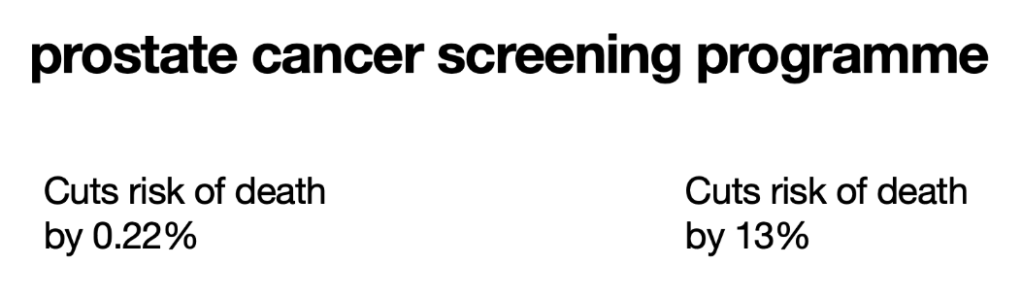
As humans, we are heavily influenced by the way that risk is presented. Relative risk or absolute risk? As a percentage, hazard or odds ratio? The figures can seem very persuasive and it is not always easy to understand what it means, especially at an individual level.

I’m a fan of Dr Margaret McCartney, a GP from Glasgow. She also has an academic role at St Andrew’s University, where she is the Director of the Centre for Evidence and Values in healthcare. She is interested in many things, including evidence based medicine, screening, risk, bias, and public communication about healthcare. What follows is her illustration on the communication of risk, focusing on a very topical issue; whether to screen for prostate cancer.

Effective communication of risk in general practice is essential not only for patient understanding but also for fostering trust and shared decision-making. Building on the foundational importance of risk communication, practitioners must tailor their approach to each patient’s level of health literacy and cultural background. This involves using clear, non-technical language, visual aids, and analogies that resonate with individual experiences, while also being mindful of the emotional impact that risk information may have.

Furthermore, engaging patients in open dialogue allows them to express concerns, ask questions, and clarify misunderstandings, which ultimately supports informed consent and adherence to management plans. By continually refining communication strategies and adapting to the evolving needs of patients, general practitioners play a pivotal role in demystifying medical risks and facilitating effective healthcare outcomes.

HOW TO COMMUNICATE RISK, BENEFIT AND HARM:

  • Use absolute risk rather than relative risk. In the PSA article, the absolute risk reduction is from 1.6% to 1.4%
  • What are the risks of a disease without treatment.
  • What are the absolute risks of harm of any particular treatment?
  • What is the burden of treatment? How will the treatment (or lack of it) affect quality of life, and for how long?

Using risk alone to guide decision making is insufficient; in the mix is the needs of you the patient, your goals, what is important and what is achievable. Few of us can remember all of the known risks of every treatment; using patient decision aids helps to support communication of risk. NICE, NHS England, Cochrane, the University of Ottawa all have decision aids of varying quality. Ask your doctor where to find the best decision support for the condition you are discussing.

What is patient-centred care?

What do we mean by patient-centred care? This isn’t a trick question but an attempt to reach a consensual answer.

A common response is that it’s about placing the patient at the centre of the care process, and seeking to address what matters to them, akin to a tailor made suit, rather than using a ‘one size fits all’ approach.

Some definitions focus on the responsibility of health professionals to inform patients about their healthcare and give them a choice. It could be more than this, with patient-centred care being about the partnership between practitioner and patient, with this relationship rooted in sharing power, rather than upholding a paternalistic attitude.

It does not mean doing everything that a patient asks; it is not ‘patient centred’ to give out diazepam and opiates without restriction when the consequence can be a hard-to-manage addiction. Being patient centred in this scenario might include a discussion about the reasons for a request, negotiating and sticking to a management plan, arranging additional psychiatric support, or a number of other options.

Patient centred care is also about designing services that meet the needs of patients rather than the needs of the organisation. This implies that the public should participate in the planning and redesign of services, and the reshaping of policy.

There are pitfalls. One commentator points out: ‘Three proposals topped a poll of options for reform at the ‘listening exercise’ attended by more than 1,000 people in Birmingham: extending GP opening hours, annual health MOTs and more walk-in centres. This familiar list of the preoccupations of the professional middle classes confirms the way in which this focus group approach places the demands of the worried well over those of the seriously ill (or even of the not very well, but socially marginal).

‘Listening exercises’ tend not to include those who are ill, particularly the elderly, children, people with mental illness or learning disabilities, families with young children, those who are not fluent in English – in fact, the majority of our patients and certainly those patients most in need of healthcare services. These proposals will increase costs out of all proportion to benefits and are likely to disrupt continuity of care for those patients for whom this is the most important aspect of primary care services.’

The concept of patient-centred care encompasses all of the above – from the organisational, redesigning services end of the patient-centred care spectrum through to the individual interactions side. However, health professionals, educationalists, managers and patient representatives are all developing different meanings that reflect their own history and position. Without a consensus about patient-centred care, it is hard to see how we can agree on how to deliver it. 

Being patient centred does not just mean responding to the demands of a vocal few. It is also about providing accessible, reliable care to the sick, the sad, and the frequent attenders, and treating all patients with common decency.

How do you weigh up medical advice?

I’ve been visiting family and friends, and as often happens, we compare medical notes. How easy is it to visit your GP? Who has the worst osteoarthritis? What medication have each of us been prescribed for high blood pressure? All of our social networks and norms are in play. Our family has a tendency to regard illness as a weakness,, and any visit to the GP involves careful callibration against the family norms.

One sister prefers to seek alternative solutions, changing her diet, drinking apple cider vinegar for her joints, and doing yoga. Another does not vist her GP or look for health issues on the internet, but pursues a very healthy lifestyle. My brother has sought private advice, my mother has checked with multiple medically-qualified relatives and friends. My dear dead dad used to boast about the top specialists he used to see, but would check in with me to see if I had heard of them, for validation.

Ever since I started medical school, I have been a sounding board for all sorts of friends and relatives, even before I had started my clinical years. In recent years, this has increased in frequency, and I have been wondering about this. Do people trust their GP and other qualified health professionals less? We can check everything on the internet, but sometimes that information is unreliable.

There are a number of factors in play. First of all, access to the internet has been growing over the last twenty five years. Artificial intelligence means that search engines can prioritise and summarise information quickly, no appointment required, any time and anywhere. Official sources of information such as NHSinform and patient.info can be a boon to health professionals, who can signpost to them for a modern take on the information leaflets we used to stock, and more likely to be up-to-date. Specialist websites provide a sense of community and support for conditions such as diabetes or muscular dystrophy.

Reliance on digital support for healthcare marginalises some groups. Statistically, older women are the least likely to be IT literate or to trust digital solutions, but low income, deprivation, language and cultural barriers are all in play. The affluent, urban, busy professional has become the target audience.

As a health professional, when I speak to a patient with high levels of understanding of their condition, and good health literacy, this is both a blessing and a stress. The fully engaged patient can participate in discussions about various health care options, can evaluate information, and challenge my own assumptions and knowledge base. This same group of patients may defer decisions so that they can evaluate and research their health questions further. It can be time consuming and intense, and of great value to the patient.

The second factor is less tangible than reliable information. It is trust. In our modern NHS, there are fewer GPs per head of population. At the same time, an older and less healthy population requires more health care. I could expand at length about the reasons for the reduction in whole-time equivalent GPs, but that is for another day. The upshot is that it has become harder to get an appointment with a GP and harder to see a GP that you have seen before. Continuity of care is disappearing, a loss to GPs and patients alike.

I polled a group of friends and relatives where they sought healthcare advice. The general approach seems to be to consider what issue to address, then to speak to friends and relatives first, perhaps supplemented by google. Only about half of these discussions led to a GP being involved at all, and any outcomes were further reviewed with relatives and friends. Clinically trained relatives, and those with the same condition, were the favoured sources of advice and discussion.

I asked these same friends and relatives about whether they usually saw the same GP, and whether they trusted their GPs. None of them could say who their GP was, or saw the same GP each time. Only half of them said they trusted their GP. I will quote one perspicacious reply:

How telling. The erosion of continuity of care has eroded trust and understanding, nuance and personalised medicine. Increasingly available and more complex information makes it harder to discriminate and evaluate the reliability of the information, how much weight to give it and whether it applies. Without trust from a wise navigator, where is realistic medicine? How do people without a clinically qualified relative cope? If General Practice has been reduced to a ‘painting by numbers’ service, how can personalised choices be considered?

What is ‘Realistic Medicine’ ?

All around the world, health care systems are talking about realistic medicine in some form or another. The words are not the same, but there is a common theme. In Canada, and in the UK, the movement is called ‘Choosing Wisely’ and in Wales, the conversation is about ‘Prudent Healthcare’. The ‘Choosing Wisely’ movement started in 2012, and is now internationally relevent, with over thirty countries and eighty specialist organisations engaged in the initiative.

At the heart of this new era in modern health care is the key idea that, just because we can do something, doesn’t mean it is right, ethical or reasonable to do it. Moreover, the goals of care for any particular patient should be the key priority against which any course of action should be measured.

Patients need trusted information that helps them understand that more care, more technical and intensive investigations and treatments are not always better. Some tests and treatments do not necessarily lead to improved health, or achieve what matters to them.

A patient’s tale. Mr M is a fictional patient on a remote island in the Hebrides. He is 84 and lives in the home he was brought up in. He is quite lonely; many of his generation have died in recent years, and surviving friends are generally not fit to drive, in residential care or in poor health. He has advanced prostate cancer, chronic kidney disease and poor mobility due to painful osteoarthritis. He is frightened of dying away from his people. When he develops urosepsis, he is admitted to the community hospital a few miles away.

Should he be flown by air ambulance to a bigger hospital where he can be treated with gentamicin, and cared for in a high dependency unit? This level of care cannot be provided in the community hospital. Or should he be managed by a GP without gentamicin?

Mr M’s goal is not to leave the island for health care, as he would prefer to die locally, so the decisions about care are about meeting this goal. The GP, the lead nurse and Mr M discuss his goals, and then the risks and benefits of treatment options. He survives this infection, and his goals are recorded in his clinical record. He is relieved that his fears are acknowledged and heeded, and he feels supported in his decision.

This movement requires excellent communication with patients and the public, so that they can be fully engaged in decisions about their care, and empowered to set the goals of that care. These conversations can be intense, personal and emotional, if they are to be really meaningful.

This does not just change individual discussions between one clinican and a patient, it informs the mindset of the whole healthcare system. Public involvement in this discussion is growing. Some national consumer groups, patient organisations and disease-specific groups are adopting these ideas, so that patients feel empowered to begin the conversation with their clinicians.

Realistic medicine should be a core part of health literacy, whatever you call it. As equal partners, doctors and patients can both ask for and engage in these conversations, however intense they are, because they are a fundamental part of providing good health care.

Words that disempower patients

Five years at medical school taught me the words that we use to describe medical concepts. Many of the terms are based in Latin or Greek, harking back over the centuries to the beginnings of medical schools.

Linguistic determinism is a concept that says that the language you use shapes the way that you think. The words we choose can change the way we limit and frame understanding, knowledge and ideas, and alter memory, categorisation, and perception. It is no surprise, then, that it affects the relationship between doctors and patients.

I have kept an article from the British Medical Journal from April 2022 to reread. It discusses the use of medical language. The authors state that the medical profession, in using elitist and outdated language, ‘casts doubt, belittles or blames patients, and jeopardises the therapeutic relationship…’

Using language in a way that disempowers patients is endemic. I’m sure, as a younger doctor, and copying the phrases of my senior colleagues, it helped me overcome imposter syndrome. This sort of language is pervasive, and using it makes you ‘one of the team’.

One example describes the situation where the clinician is struggling to make sense of the patient’s story within the clinician’s attention span. The patient is described as being ‘a poor historian’ when their narrative account of their symptoms does not meet the expectations of the clinician. It is the clinician’s duty to listen, to understand their story, concerns and expectations. Our skill as doctors, nurses, or other health professionals, is to ask the right questions, to listen carefully and to recount the clinical history accurately.

Other examples, with alternative words:

  • Presenting complaint – reason for attendance – ‘complain’ has negative connotations.
  • Ceiling of care – goals of care – ‘ceiling’ implies a limit to the treatment on offer.
  • Not compliant – this phrase is used when the patient did not follow instructions, but there is usually no mention as to whether the patient had agreed to the initial plan. We could write ‘barriers to adherence include …’
  • Did not attend – barriers to attendance – some patients really struggle with transport, mental health, organisational skills; by identifying the barriers, we can help patients access care.
  • Patient claims – patient reports – ‘claim’ implies that the patient is not being truthful.
  • Patient denies – patient did not experience – ‘deny’ implies a lack of truthfulness, of withholding information.
  • Patient refused – patient declined
  • ‘Has the patient been consented?’ – in this example, the patient is a passive recipient of information, no record of what the patient has understood and retained about a procedure.
  • Substance abuse – has a substance use disorder – the first phrase is associated with patient blame.

Patients can report feeling child-like in clinical settings. For example in a diabetic setting, blood sugars can be ‘good’; does the opposite imply that the patient has been naughty and bad? Some patients recount feeling as if they have been scolded for their poor outcomes, or ‘treatment failure’.

Every so often, I come across another phrase that is part of routine clinical discussion, and discover a more human, collaborative way of putting my view across. I hope to find ways of validating the patient experience, and allowing patients the opportunity to collaborate in creating their care plans.

The key messages from the article:

  • Some commonly used language in healthcare characterises patients as petulant, passive, or blames them for poor outcomes.
  • Such language negatively affects patient-provider relationships and is outdated.
  • Clinicians should consider how their language affects attitudes and change as necessary.
  • Changing our language to improve trust and support shared decision-making is unlikely to harm patients.
  • Better use of language may help us to reach more patient-centred and realistic care plans.

How does this relate to realistic medicine? The core of this is patient choice, and it is for us to communicate well, so that the patient can make this choice well-informed.

Linguistic determinism https://en.wikipedia.org/wiki/Linguistic_determinism – The concept that language and grammar affect the way we limit and frame understanding, knowledge and thought, for example, memory, categorisation, and perception.

The article by Caitríona Cox and Zoë Fritz was published in the BMJ on 30th April 2022, (you can read it here: https://www.bmj.com/content/377/bmj-2021-066720)

PILLS AND THE PLANET

I’ve been reading the BMJ again, and finding articles that require us to inspire patients, to help them understand and benefit from our knowledge. This time, I’m introducing an excellent article that appeared in March 2024, written by Emma Lim, Emily Parker and Nicola Vasey. I’ve pinched their statistics.

A couple of years ago now, we saw a surge of cases of scarlet fever, an infectious disease that is treatable with antibiotics. It affects children in particular. At the same time there was a shortage of the liquid preparations of the most suitable antibiotic. It led me to look at Kidzmed, an online resource that helps parents support their children to take tablets.

It led to a reflection. As a child, living in New Zealand at the time, I suffered from recurrent tonsillitis. I was often prescribed antibiotics, and I vividly recall the vile taste of penicillin mixture, and trying to sweeten it with sugar when my mother wasn’t looking. At some point, there must have been a shortage, and the only option was capsules. I was 4, and I managed. Celebration all round, no bad taste and I was so proud that I was grown up enough to manage.

Another childhood memory – my sister and I putting our thrupenny bits in our mouths; it was our pocket money, and we must have been five and six years old. Alice swallowed hers. OOPS, but down it went, and out it came a day later. My brother also managed to swallow an old 50p piece, also without harm, although that caused more excitement on account of the size, and this is not recommended at all, but out it came a day later. Children swallow all sorts of things, often money. Tablets are usually smaller. A note here – small batteries and magnets are also easy to swallow and with much more risk of serious harm than money.

I also remember, as a parent, the relief that our children could manage tablets. No more the risk of travelling with a bottle of paracetamol, sticky and at risk of breaking, not allowed on the plane if it was more than 100ml. Much easier if we could take tablets.

In reality, most capsules and pills are smaller than the amount of food we can manage in a swallow, so it should be easy. The firm consistency of larger tablets can be difficult for some people, but taking tablets with a good swallow of water gets them past the back of the throat and off they go.

Roll on two years. I have read an article in the BMJ about the impact of moving from liquid formulations to pills and capsules. It isn’t just about ensuring that children can get the full range of medications they need, without the bad taste. Medication accounts for 25% of the NHS carbon footprint. In India, a lifecycle assessment of liquid paracetamol versus pills showed that liquid consumes fifteen times the amount of carbon. Some of this is in the cost of transporting a heavier product, with more wasteful packaging.

Pills also have a longer shelf life, and generally don’t need to be stored in the fridge, so there is lower energy use and less waste. They also contain less additives such as colouring, flavouring and stabilisers. Pills can be dispensed in exact quantities, whereas liquids are prescribed by the bottle. This is especially true of antibiotics such as amoxicillin liquid which comes in 100ml, where a course is usually 75ml. Liquids are also more prone to measurement error; 80% of doses measured by parents in a trial had a small error, and 21% of those errors were very large.

Pill swallowing is a life skill that benefits parents, families and the environment. It is especially helpful for children who have chronic diseases such as epilepsy or cystic fibrosis. Children as young as four years old can be trained to swallow pills.

I recommend visiting Kidzmed for information, it really works. Practice with small sweets, and use a bottle with a drinking lid on it. Work up through the sizes and reinforce success with praise and prizes. It is also a good opportunity to talk to your child about being safe with medicines and not swallowing things that are unsafe.

  • Find a comfortable place with no distractions, and explain what the objective is.
  • Let the child choose their own drink
  • Start with the smallest practice pill or sweet
  • Put the sweet or practice pill on the centre of the tongue
  • Take three gulps of liquid
  • Try another pill or sweet following the same steps. Use the words ‘the next one’ rather than ‘the bigger one’.

https://www.youtube.com/watch?v=XwiuU-k2FIM – the video is 14 minutes long.

https://www.nenc-healthiertogether.nhs.uk/parentscarers/medicine-children/pill-swallowing-kidzmed for some more background and some extra resources.

Realistic medicine saves the planet? Sustainability, environment and health

I am Dr Kate Dawson, one of the GPs at Benbecula Medical Practice in the Outer Hebrides. I have been working here since 1990, with three short breaks to complete some training, and when I had my babies, who are now grown up. We are lucky to live in a beautiful and precious place, which is generally safe and kind. I love gardening, knitting, and observing our wildlife when I am out walking.


Our islands, though, are very vulnerable to change. Global warming is bringing unpredictable weather, and rising sea levels will change our coastlines. It is getting more difficult to recruit staff, and travel links are not as good as they were a few years ago.


In the face of this, I have been considering the sustainability of the healthcare system that I am part of, and how we can make positive changes that will help our patients achieve better health, and at the same time, reducing our impact on resources. I dived in to think about this in more detail in the last year and found more than I thought possible.


What does sustainability and the environment mean in terms of health care? Here are some of the ideas that may affect patients directly. Some items will not surprise you, others might.

  • Patient transport. This includes trying to use active transport such as walking and cycling, using electric bikes and electric cars. This can be hard when distances are long, and our roads are narrow. However, this also includes trying to avoid travel to appointments when a phone call or video link would be as effective.
  • Waste management: Unused medication should be returned to the surgery for safe disposal, so it does not cause environmental contamination. You can also help by only ordering what you need when ordering repeat prescriptions. Empty inhalers and insulin pens should be returned to the surgery. Incinerating empty inhalers causes less damage than the gas in the inhaler being left in the environment.
  • Better prescribing: As an example, inhalers have a particularly detrimental effect on the environment. One MDI inhaler is as damaging as a drive to Inverness, whereas one breath-activated inhaler is equivalent of a drive between Griminish and Balivanich. Unnecessary and ineffective medication is a waste too. Don’t cut down on your inhalers, get advice about managing your asthma more effectively, use your preventer more, and ask to try a switch to breath activated inhalers.
  • Better decisions: Better discussions about treatment and referral help patients and doctors make better decisions. If you are referred for a treatment that you Don’t really want, or which may not benefit you much, then it is far better to discuss this before the travel, prescribing, tests and worry begin. It begins with talking frankly to your GP about the benefits, risks, and alternatives to the proposed treatment, and to ask what would happen if you did not seek treatment. Take someone with you if you need support with these discussions.
  • Good health is more than medication: Our current medical model from the twentieth century has been about patients coming to the doctors, their ailments quickly assessed, and a treatment or procedure prescribed. With authoritarian health care, the patient can become a passive recipient of medical care, and every ailment is met with a treatment or a procedure. There may be another healthier, less wasteful, more sustainable way.

Imagine this; you can improve your appearance, reduce your need for medication, your reliance on health care, improve your energy levels and joy in life, the benefits will last for years, and the cost is minimal. I am really excited with the possibilities. What is the secret? What if everyone could do this, it would reduce reliance on health care resources, and we would live to enjoy health into our retirement. I am talking about improving health by improving fitness.


As an example, the most cost-effective treatments for Chronic Airways Disease (COPD) are physical activity, smoking cessation, and flu immunisation. These three things are associated with better outcomes than any inhaler or medication.


I am using the word ‘fitness’ for a good reason, as it covers lots of concepts. It does not focus specifically on weight, or exercise, or smoking, or alcohol. It just focuses on being healthier. Where should you start? The beginning is to think about what you want to improve, to imagine what your goal is, what is driving you to consider making a change. Give yourself permission to write down or say aloud what you want to change, what could be better. Perhaps you want to be less short of breath, or your knees to hurt less, or to feel less lonely. Your goal will inspire you to keep trying. You could list all the things you might want to change and work out what you need to do for each thing.


Don’t try to change everything all at once. It is better to focus on one easy thing at a time and make it about fitness and fun. This year, for example, I plan to go for a walk at least once a week. If I miss a week, I have given myself permission to try again the next week, and not to give up when I fail. Last year, we started using smaller plates to reduce our portion sizes without cutting out our favourite foods. You Don’t need Lycra, or to run, or to go on an extreme diet, just find one thing that you can do, that you can enjoy, and make that into a habit that you can sustain.


Who are your allies? Have you got a trusted friend to talk to? A professional such as a physiotherapist, counsellor, nurse, or doctor could listen and support you, if you asked for this; the most important thing is to find someone who can listen to you. They may help you work out what you might be able to do next, to identify one thing that you can do easily, and to support you too.
Your one change may bring more benefits than you think. Going for a short walk will improve your fitness, and it will also raise your mood, reduce isolation, and ease joint pain. Meeting up with someone else for an activity such as knitting or singing will improve your mental agility, and will also reduce isolation, low mood, and loneliness.


As you start to improve your health, you may inspire others. We could have a new normal, in which we support each other to take steps to improve our health through simple changes to our lifestyles, reducing our reliance on medication and leading more fulfilling and joyful lives. We can help the environment and the NHS stay sustainable by creating our own better health.


For ideas, why not listen to Michael Mosley’s podcast ‘just one thing’ on BBC sounds.
https://www.bbc.co.uk/programmes/p09by3yy/episodes/downloads
My grandmother; what happens without anticipatory care planning.

My grandmother was called Susannah Margaret Helena Mence Davies (nee Bird). She was very small and very elegant. I can remember her doing magic tricks with her pastel shaded Sobranie Cocktail cigarettes, her long fingernails, her colourful and unique dresses. She was also a fine artist, and an instinctive garden designer.

When I was a medical student, she developed one of those mysterious auto-immune diseases that could only be treated with high doses of steroids, and she started to shrink and shuffle.

When I was a junior doctor, she died, and it was terrible. I was a first year SHO, and while I knew the theory of what happened with a perforated bowel, the reality was and still is difficult to accept. She had started to bleed, with abdominal pain, at a social event, and kept a stiff upper lip then and for a few days afterwards, until she collapsed. This was back in the days when omeprazole was a new, specialist drug.

I got a phone call from my mother to explain what had happened, and heard that she had a perforated ulcer that had been three days in the making. I knew how frail she was, and I blurted out that she was likely to die. Although that was a shocking, unfiltered, response, it was in retrospect quite helpful. It allowed my mother and my aunt prepare themselves for what came next.

I drove down from Liverpool to Oxford, to see her. She was pitiful. She was conscious, she was in pain, she was in ITU in one of those gowns that falls open at the back, in a large area where many patients were being cared for, very little privacy. She told me that she wanted to die, that her body had had enough.

I spoke to her consultant, and asked them why? Why was she on renal-dose dopamine? Why was she in ITU? I was too green to take them to task, but I think the team had been wanting to tell me a hopeful tale of ‘everything being done’ when I knew and she knew she just wanted to go, that her illness was probably unsurvivable.

The next day, my aunt intervened, and she was moved to a wee side ward, and my grandfather and my aunt sat with her until she died, with a massive haematemesis.

Wind on all these decades later, and this experience informs me. I know how hard it is, as a relative, to ask the difficult questions of the medical team, how hard it is to say words that are culturally not that acceptable. Are you letting them die, or giving them the grace to go when it is their time. Time has passed; terms like ‘ceiling of care’ ‘ACP’ ‘treatment escalation plan’ were not around.

I’m sure if we’d talked about this seriously as a family, we would have been ready for the difficult conversations, we could have been ready to talk to the consultants, we could have been prepared for the end. Would we have admitted her to hospital? Possibly, but she would never have been in ITU, in pain, indignity and fear. The wait of three days was telling; was she putting off seeking help because she didn’t want to be saved? How frightening not to trust the health professionals to heed your wishes, so that you stay at home in pain, trying to conceal the beginnings of your end.

This still happens, and I want it to stop.

We should be having conversations in our families. We shouldn’t force our relatives to second-guess our wishes, when the stakes are high. We should have a plan, some realistic principles to guide us through the difficult last days. We should not be trying to resist the inevitable, raising unrealistic hopes for what might happen.

This also goes hand in hand with sorting out Power of Attorney, designating someone you trust to speak and intercede on your behalf when you are unable to do so. Don’t forget to tell them your wishes while you are still able. Look after your future self while you are still able.

For examples of anticipatory and advance care planning, here are some links:

When I Am In Doubt

By Dr Chris Nickson

When I am in doubt I talk to surgeons.
I know that they will know what to do.
They seem so sure.

Once I talked to a surgeon.
He said that when he is in doubt
He talks to priests.
Priests will know what to do.
Priests seem so sure.

Once I talked to a priest.
He said that when he is in doubt
He talks to God.
God will know what to do.
God seems so sure.

Once I talked to God.
He said that when he is in doubt
He thinks of me.
He says I will know what to do.
I seem so sure.